Blog

Lent with Bonhoeffer: Discipline of Prayer

img_0683-1

Thursday, March 15, 2018

We meditate because we need a firm discipline of prayer. We like to pray according to our moods–briefly, at length, or not at all. But that is to be arbitrary. Prayer is not a free-will offering to God; it is an obligatory service, something that He requires. We are not free to engage in it according to our own wishes. Prayer is the first divine service in the day. God requires that we take time for this service. “Early in the morning I cry out to you, for in your word is my trust. My eyes are open in the night watches, that I may meditate upon your promise” (Psalm 119:147-148). “Seven times a day do I praise you, because of your righteous judgments” (Psalm 119:164). God needed time before he came to us in Christ for our salvation. He needs time before he comes into our heart for our salvation.

-from Meditating on the Word, pg. 23
Lent with Bonhoeffer: We Meditate Because We Proclaim the Gospel

img_0683-1

Wednesday, March 14, 2018

We meditate because we are proclaimers of the Gospel. We cannot expound the Scripture for others if we do not let it speak daily to us. We will misuse the Word in our office as proclaimer of the Gospel if we do not continue to meditate upon it in prayer. If the Word has become empty for us in our daily administrations, if we no longer experience it, that proves we have not let the Word speak personally to us for a long time. We will offend against our calling if we do not seek each day in prayer the Word that our Lord wants to say to us for that day. Proclaimers of the Word are especially called upon to perform the office of prayer: “But we will devote ourselves to prayer and to the ministry of the Word” (Acts 6:4).

-from Meditating on the Word, pg. 23
Lent with Bonhoeffer: We Meditate Because We are Christians

img_0683-1

Tuesday, March 13, 2018

We meditate because we are Christians. Therefore, every day in which we do not penetrate more deeply into the knowledge of God’s Word in Holy Scripture is a lost day for us. We can only move forward with certainty upon the firm ground of the Word of God. And, as a Christian, we learn to know the Holy Scripture in no other way than by hearing the word preached and by prayerful meditation.

-from Meditating on the Word, pg. 22

Lent with Bonhoeffer: Enduring Evil

Testament to freedom

Monday, March 12, 2018

By willing endurance we cause suffering to pass. Evil becomes a spent force when we put up no resistance. By refusing to pay back the enemy in his own coin, and by preferring to suffer without resistance, the Christian exhibits the sinfulness of contumely and insult. Violence stands condemned by its failure to evoke counter-violence. When a man unjustly demands that I should give him my coat, I offer him my cloak also, and so counter his demand; when he requires me to go the other mile, I go willingly, and show up his exploitation of my service for what it is. To leave everything behind at the call of Christ is to be content with him alone, and follow only him. By their willingly renouncing self-defense, Christians affirm their absolute adherence to Jesus, and their freedom from the tyranny of their own ego. The exclusiveness of this adherence is the only power which can overcome evil.

-from A Testament to Freedom, pg. 317

Lent with Bonhoeffer: Fueling Evil

Testament to freedom

Fourth Sunday in Lent, March 11, 2018

The only way to overcome evil is to let it run itself to a standstill because it does not find the resistance it is looking for. Resistance merely creates further evil and adds fuel to the flames. But when evil meets no opposition and encounters no obstacle but only patient endurance, its sting is drawn, and at last it meets an opponent which is more than its match. Of course this can only happen when the last ounce of resistance is abandoned, and the renunciation of revenge is complete. Then evil cannot find its mark, it can breed no further evil, and is left barren.

-from A Testament to Freedom, pg. 317

Lent with Bonhoeffer: The New Humanity

img_1244Saturday, March 10, 2018

Where it is recognized that the power of death has been broken, where the miracle of the resurrection and new life shines right into the world of death, there one demands no eternities from life. One takes from life what it offers, not all or nothing, but good things and bad, important things and unimportant, joy and pain. One doesn’t cling anxiously to life, but neither does one throw it lightly away. One is content with measured time and does not attribute eternity to earthly things. One leaves to death the limited right that it still has. But one expects the new human being and the new world only from beyond death, from the power that has conquered death. Within the risen Christ the new humanity is borne, the final, sovereign ‘Yes’ of God to the new human being. Humanity still lives, of course, in the old, but is already beyond the old. Humanity still lives, of course, in a world of death, but is already beyond death. Humanity still lives, of course, in a world of sin, but we are already beyond sin. The night is not yet over, but day is already dawning.

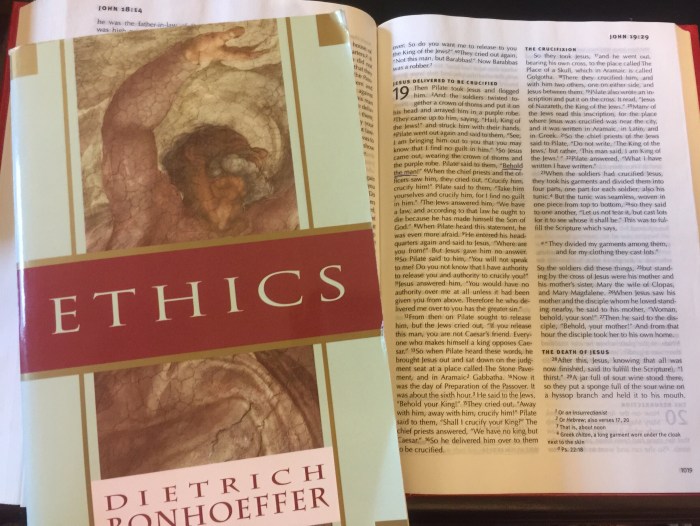
-from Ethics, pg. 92

Lent with Bonhoeffer: The Idolization of Death

img_1244

Friday, March 9, 2018

The miracle of Christ’s resurrection has overturned the idolization of death that rules among us. Where death is final, fear of it combines with defiance. Where death is final, earthly life is all or nothing. Defiant striving for earthly eternities goes together with a careless playing with life, anxious affirmation of life with an indifferent contempt for life. Nothing betrays the idolization of death more clearly than when an era claims to build for eternity, and yet life in that era is worth nothing, when big words are spoken about a new humanity, a new world, a new society that will be created, and all this newness consists only in the annihilation of existing life. The radicality of this ‘Yes’ and ‘No’ to earthly life reveals that only death counts. To rake in everything or to throw away everything, this is the attitude of one who believes fanatically in death.

-from Ethics, pg. 91-92

Lent with Bonhoeffer: Victory!

Testament to freedom

Thursday, March 8, 2018

In our lives we don’t speak readily of victory. It is too big a word for us. We have suffered too many defeats in our lives; victory has been thwarted again and again by too many weak hours, too many gross sins. But isn’t it true that the spirit within us yearns for this word, for the final victory over the sin and anxious fear of death in our lives? And now God’s Word also says nothing to us about our victory; it doesn’t promise us that we (by ourselves) will be victorious over sin and death from now on; rather, it says with all its might that someone has won this victory, and that this person, if we have him as Lord, will also win the victory over us. It is not we who are victorious, but Jesus. We proclaim that today and believe it despite the death that the war brings upon us again. We see the supremacy of death; yet we proclaim and believe the victory of Jesus Christ over death. Death is swallowed up in victory. Jesus is the victor, the resurrection of the dead, and everlasting life.

-from A Testament to Freedom, pgs. 298-299

Lent with Bonhoeffer: Seeking Peace

Testament to freedom

Wednesday, March 7. 2018

A Christian life proves itself not in words, but character. No one is a Christian without character…. Only those who persevere are experienced and produce character. Those who do not persevere experience nothing that will build character. To whomever God wants to grant such experience–to an individual or to a church–to them God sends much temptation, restlessness, and anxiety; they must cry out daily and hourly for the peace of God. The experience that is talked of here leads us into the depths of hell, to the jaws of death, and into the night of unbelief. But through all of that, God does not want to take God’s peace from us. Throughout, we experience God’s power and victory, and the ultimate peace at Christ’s cross more with each passing day.

-from A Testament to Freedom, pg. 292

Lent with Bonhoeffer: Remaining Underneath

Testament to freedom

Tuesday, March 6, 2018

Perseverance, translated literally, means: remaining underneath, not throwing off the load, but bearing it. We know much too little in the church today about the peculiar blessing of bearing. Bearing, not shaking off; bearing, but not collapsing either; bearing as Christ bore the cross, remaining underneath, and there beneath it–to find Christ. If God imposes a load; then those who persevere bow their heads and believe that it is good for them to be humbled–remain underneath! But remaining underneath. For remaining steadfast, remaining strong is meant here too; not weak acquiescence or surrender, not masochism, but growing stronger under the load, as under God’s grace, imperturbably preserving the peace of God. God’s peace is found with those who persevere.

-from A Testament to Freedom, pg. 291