Advent with Barth: Revelation and Reconciliation (A Brief Reflection on God’s Revelation of Jesus Christ)

“Everyone marries a stranger.”

As I prepare to perform my first marriage in April, the words of my friend and fellow pastor, Tom Cannon, haunt me. He’s right, of course. I think most couples who’ve been married, even for a little bit, know this. You don’t really know who you’ve married until you’re married.

So how do you counsel two strangers who have made the decision to spend the rest of their lives together? How can two people decide to become one flesh in the first place?

If we can know so little about our spouses before we marry them, if our spouses can remain mysteries to us even years after our weddings, then how can we claim to know God? My spouse is at least another human. I’ve spent more time with her than anyone else. Yet if I don’t even know her as well as I think I should, how can I know the God of the universe? Of course, whatever I know about my spouse is by what she shows me. And what we know about God is what God shows us. This is revelation. But this revelation does not happen haphazardly (as is often the case with learning about our spouses). God does not give us bits of data that we can contemplate and place into neat categories. God’s revelation is a gift, something imparted to us.

Indeed, God’s revelation is Someone who comes to us. We cannot master this Someone who comes to us; we must be mastered by him.

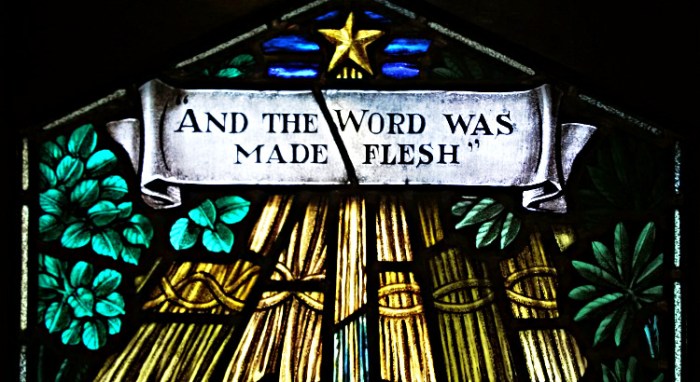
This Someone is Jesus Christ. Holy Scripture attests to this revelation of God as the Word (John 1:1-14), specifically the Word that was made flesh, the incarnation of his Word. For Barth, the incarnation of God’s Word is the objective reality of God’s revelation. God is always the Subject of his own revelation – it is his revelation, by him and about him, not us. The Holy Spirit in us is the subjective reality of this revelation – God is at work in us to fulfill his revelation.

 But Jesus as the objective realityof God’s revelation stands outside of us. As such, we are always talking about a mystery, what Barth calls “the prime mystery.” Jesus Christ cannot be pinned down by us. We are dominated by this Someone who is above us.

And yet, he is one of us. The Creator of this world is a member of this world. The Maker of human beings has become a human being. In Jesus Christ, God is both revelation to us and our reconciliation with him. God shows us who he is by becoming one of us, and in becoming one of us, he restores us to relationship with him.

Even in this relationship, we cannot say that we know him (like we might be bold enough to say about our spouses after a few years). The best we can do is acknowledge him; we confess him as very God and very man. The prime mystery of God’s revelation remains a mystery to us. But the miracle of Christmas is that he is no longer a stranger. He is our Bridegroom. Amen.

DAILY DEVOTIONAL, 12/4/18

Tuesday, 1st Week of Advent

Opening Prayer

Oh Lord, open my lips
And my mouth shall proclaim your praise. (Ps. 51:15)

(from The Book of Common Worship)
Eternal God,
through long generations you prepared a way
for the coming of your Son,
and by your Spirit
you still bring light to illumine our paths.
Renew us in faith and hope
that we may welcome Christ to rule our thoughts
and claim our love,
as Lord of lords and King of kings,
to whom be glory always.
Amen.

Morning Psalm, Psalm 33

The Steadfast Love of the Lord

33:1 Shout for joy in the Lord, O you righteous!
Praise befits the upright.
2 Give thanks to the Lord with the lyre;
make melody to him with the harp of ten strings!
3 Sing to him a new song;
play skillfully on the strings, with loud shouts.
4 For the word of the Lord is upright,
and all his work is done in faithfulness.
5 He loves righteousness and justice;
the earth is full of the steadfast love of the Lord.
6 By the word of the Lord the heavens were made,
and by the breath of his mouth all their host.
7 He gathers the waters of the sea as a heap;
he puts the deeps in storehouses.
8 Let all the earth fear the Lord;
let all the inhabitants of the world stand in awe of him!
9 For he spoke, and it came to be;
he commanded, and it stood firm.
10 The Lord brings the counsel of the nations to nothing;
he frustrates the plans of the peoples.
11 The counsel of the Lord stands forever,
the plans of his heart to all generations.
12 Blessed is the nation whose God is the Lord,
the people whom he has chosen as his heritage!
13 The Lord looks down from heaven;
he sees all the children of man;
14 from where he sits enthroned he looks out
on all the inhabitants of the earth,
15 he who fashions the hearts of them all
and observes all their deeds.
16 The king is not saved by his great army;
a warrior is not delivered by his great strength.
17 The war horse is a false hope for salvation,
and by its great might it cannot rescue.
18 Behold, the eye of the Lord is on those who fear him,
on those who hope in his steadfast love,
19 that he may deliver their soul from death
and keep them alive in famine.
20 Our soul waits for the Lord;
he is our help and our shield.
21 For our heart is glad in him,
because we trust in his holy name.
22 Let your steadfast love, O Lord, be upon us,
even as we hope in you.

Prayer:
(from The Book of Common Worship)
Lord God,
with your Son you made heaven and earth,
and through him you continue to accomplish your purpose for creation.
Make us witnesses to your truth and instruments of your peace,
that all may know you are the God of justice,
and trust your holy name;
through Jesus Christ our Savior.
Amen.

Psalm of Praise, Psalm 146

Put Not Your Trust in Princes

146:1 Praise the Lord!
Praise the Lord, O my soul!
2 I will praise the Lord as long as I live;
I will sing praises to my God while I have my being.
3 Put not your trust in princes,
in a son of man, in whom there is no salvation.
4 When his breath departs, he returns to the earth;
on that very day his plans perish.
5 Blessed is he whose help is the God of Jacob,
whose hope is in the Lord his God,
6 who made heaven and earth,
the sea, and all that is in them,
who keeps faith forever;
7 who executes justice for the oppressed,
who gives food to the hungry.
The Lord sets the prisoners free;
8 the Lord opens the eyes of the blind.
The Lord lifts up those who are bowed down;
the Lord loves the righteous.
9 The Lord watches over the sojourners;
he upholds the widow and the fatherless,
but the way of the wicked he brings to ruin.
10 The Lord will reign forever,
your God, O Zion, to all generations.
Praise the Lord!

Prayer:
(from The Book of Common Worship)
Blessed are those who put their trust in you, O God,
our sure rock and refuge.
Guard us from giving to any other
the allegiance which belongs only to you.
Shine upon us with the brightness of your light,
that we may love you with a pure heart
and praise you forever;
through Jesus Christ our Lord.
Amen.

Old Testament Reading, Isaiah 1:21-31

The Unfaithful City

1:21 How the faithful city
has become a whore,
she who was full of justice!
Righteousness lodged in her,
but now murderers.
22 Your silver has become dross,
your best wine mixed with water.
23 Your princes are rebels
and companions of thieves.
Everyone loves a bribe
and runs after gifts.
They do not bring justice to the fatherless,
and the widow’s cause does not come to them.
24 Therefore the Lord declares,
the Lord of hosts,
the Mighty One of Israel:
“Ah, I will get relief from my enemies
and avenge myself on my foes.
25 I will turn my hand against you
and will smelt away your dross as with lye
and remove all your alloy.
26 And I will restore your judges as at the first,
and your counselors as at the beginning.
Afterward you shall be called the city of righteousness,
the faithful city.”
27 Zion shall be redeemed by justice,
and those in her who repent, by righteousness.
28 But rebels and sinners shall be broken together,
and those who forsake the Lord shall be consumed.
29 For they shall be ashamed of the oaks
that you desired;
and you shall blush for the gardens
that you have chosen.
30 For you shall be like an oak
whose leaf withers,
and like a garden without water.
31 And the strong shall become tinder,
and his work a spark,
and both of them shall burn together,
with none to quench them.

Epistle Reading, 1 Thessalonians 2:1-12

Paul’s Ministry to the Thessalonians

2:1 For you yourselves know, brothers, that our coming to you was not in vain.2 But though we had already suffered and been shamefully treated at Philippi, as you know, we had boldness in our God to declare to you the gospel of God in the midst of much conflict. 3 For our appeal does not spring from error or impurity or any attempt to deceive, 4 but just as we have been approved by God to be entrusted with the gospel, so we speak, not to please man, but to please God who tests our hearts. 5 For we never came with words of flattery, as you know, nor with a pretext for greed—God is witness. 6 Nor did we seek glory from people, whether from you or from others, though we could have made demands as apostles of Christ. 7 But we were gentle among you, like a nursing mother taking care of her own children. 8 So, being affectionately desirous of you, we were ready to share with you not only the gospel of God but also our own selves, because you had become very dear to us.
9 For you remember, brothers, our labor and toil: we worked night and day, that we might not be a burden to any of you, while we proclaimed to you the gospel of God. 10 You are witnesses, and God also, how holy and righteous and blameless was our conduct toward you believers. 11 For you know how, like a father with his children, 12 we exhorted each one of you and encouraged you and charged you to walk in a manner worthy of God, who calls you into his own kingdom and glory.

Gospel Reading, Luke 20:9-18

The Parable of the Wicked Tenants

20:9 And he began to tell the people this parable: “A man planted a vineyard and let it out to tenants and went into another country for a long while. 10 When the time came, he sent a servant[a to the tenants, so that they would give him some of the fruit of the vineyard. But the tenants beat him and sent him away empty-handed.11 And he sent another servant. But they also beat and treated him shamefully, and sent him away empty-handed. 12 And he sent yet a third. This one also they wounded and cast out. 13 Then the owner of the vineyard said, ‘What shall I do? I will send my beloved son; perhaps they will respect him.’ 14 But when the tenants saw him, they said to themselves, ‘This is the heir. Let us kill him, so that the inheritance may be ours.’ 15 And they threw him out of the vineyard and killed him. What then will the owner of the vineyard do to them? 16 He will come and destroy those tenants and give the vineyard to others.” When they heard this, they said, “Surely not!” 17 But he looked directly at them and said, “What then is this that is written:
“‘The stone that the builders rejected
has become the cornerstone’?
18 Everyone who falls on that stone will be broken to pieces, and when it falls on anyone, it will crush him.”

REFLECTION FOR THE DAY

“The Marvel of the Incarnation”
from a sermon by
Gregory of Nazianzus (4th Century)
as reprinted in The Liturgy of the Hours

The very Son of God, older than the ages, the invisible, the incomprehensible, the incorporeal, the beginning of beginning, the light of light, the fountain of life and immortality, the image of the archetype, the immovable seal, the perfect likeness, the definition and word of the Father: he it is who comes to his own image and takes our nature for the good of our nature, and unites himself to an intelligent soul for the good of my soul, to purify like by like. He takes to himself all that is human, except for sin. He was conceived by the Virgin Mary, who had been first prepared in soul and body by the Spirit; his coming to birth had to be treated with honour, virginity had to receive new honour. He comes forth as God, in the human nature he has taken, one being, made of two contrary elements, flesh and spirit. Spirit gave divinity, flesh received it.

He who makes rich is made poor; he takes on the poverty of my flesh, that I may gain the riches of his divinity. He who is full is made empty; he is emptied for a brief space of his glory, that I may share in his fullness. What is this wealth of goodness? What is this mystery that surrounds me? I received the likeness of God, but failed to keep it. He takes on my flesh, to bring salvation to the image, immortality to the flesh. He enters into a second union with us, a union far more wonderful than the first.
Holiness had to be brought to man by the humanity assumed by one who was God, so that God might overcome the tyrant by force and so deliver us and lead us back to himself through the mediation of his Son. The Son arranged this for the honour of the Father, to whom the Son is clearly obedient in all things.

The Good Shepherd, who lays down his life for the sheep, came in search of the straying sheep to the mountains and hills on which you used to offer sacrifice. When he found it, he took it on the shoulders that bore the wood of the cross, and led it back to the life of heaven.

Christ, the light of all lights, follows John, the lamp that goes before him. The Word of God follows the voice in the wilderness; the bridegroom follows the bridegroom’s friend, who prepares a worthy people for the Lord by cleansing them by water in preparation for the Spirit.

We need God to take our flesh and die, that we might live. We have died with him, that we may be purified. We have risen again with him, because we have died with him. We have been glorified with him, because we have risen again with him.

Prayer for the Day

Take time to reflect and pray. Pray for those listed on our prayer list from worship. If you’d like to use it, here is a prayer to guide you:

(from The Book of Common Worship)
Eternal God, we thank you for being with us today, and for every sign of your truth and love in Jesus Christ. Especially we thank you for

the gift of peace in Christ . . .
reconciliation in our relationships . . .
each new insight into your love . . .
energy and courage to share your love . . .
the ministries of the church. . . .

Gracious God, we remember in our own hearts the needs of others, that we may
reach up to claim your love for them, and reach out to give your love in the name of Christ. Especially we pray for

racial harmony and justice . . .
those imprisoned . . .
strangers we have met today . . .
friends who are bereaved . . .
Orthodox and Coptic churches. . . .

Amen.

Closing Prayer

(from The Liturgy of the Hours)
Look with favor, Lord God, on our petitions,
and in our trials grant us your compassionate help,
that, consoled by the presence of your Son,
whose coming we now await,
we may be tainted no longer
by the corruption of former ways.
Through our Lord Jesus Christ, your Son,
who lives and reigns with you in the unity of the Holy Spirit,
one God, for ever and ever.


Let us praise the Lord.
– And give him thanks.
Amen.

DAILY DEVOTIONAL, 12/3/18

Monday, 1st Week of Advent

Opening Prayer

Oh Lord, open my lips
And my mouth shall proclaim your praise. (Ps. 51:15)

(from The Book of Common Worship)
Faithful God,
your promises stand unshaken through all generations.
Renew us in hope,
that we may be awake and alert
watching for the glorious return of Jesus Christ,
our judge and savior,
who lives and reigns with you in the unity of the Holy Spirit,
one God, forever and ever.

Amen.

Morning Psalm, Psalm 122

Let Us Go to the House of the Lord
A Song of Ascents. Of David.

122:1 I was glad when they said to me,
    “Let us go to the house of the Lord!”
Our feet have been standing
    within your gates, O Jerusalem!
Jerusalem—built as a city
    that is bound firmly together,
to which the tribes go up,
    the tribes of the Lord,
as was decreed for Israel,
    to give thanks to the name of the Lord.
There thrones for judgment were set,
    the thrones of the house of David.
Pray for the peace of Jerusalem!
    “May they be secure who love you!
Peace be within your walls
    and security within your towers!”
For my brothers and companions’ sake
    I will say, “Peace be within you!”
For the sake of the house of the Lord our God,
    I will seek your good.

Prayer:
(from The Book of Common Worship)
Lord Jesus,
because there was no peace in Jerusalem,
you wept hard tears.
Bring all nations under your rule
that they make peace
and, with thanksgiving
enter together the heavenly Jerusalem
where you live and reign with the Father
and the Holy Spirit, now and forever.
Amen.

Psalm of Praise, Psalm 145

Great Is the LORD
A Song of Praise. Of David.

145:1 I will extol you, my God and King,
    and bless your name forever and ever.
Every day I will bless you
    and praise your name forever and ever.
Great is the Lord, and greatly to be praised,
    and his greatness is unsearchable.
One generation shall commend your works to another,
    and shall declare your mighty acts.
On the glorious splendor of your majesty,
    and on your wondrous works, I will meditate.
They shall speak of the might of your awesome deeds,
    and I will declare your greatness.
They shall pour forth the fame of your abundant goodness
    and shall sing aloud of your righteousness.
The Lord is gracious and merciful,
    slow to anger and abounding in steadfast love.
The Lord is good to all,
    and his mercy is over all that he has made.
10 All your works shall give thanks to you, O Lord,
    and all your saints shall bless you!
11 They shall speak of the glory of your kingdom
    and tell of your power,
12 to make known to the children of man your mighty deeds,
    and the glorious splendor of your kingdom.
13 Your kingdom is an everlasting kingdom,
    and your dominion endures throughout all generations.
The Lord is faithful in all his words
    and kind in all his works.
14 The Lord upholds all who are falling
    and raises up all who are bowed down.
15 The eyes of all look to you,
    and you give them their food in due season.
16 You open your hand;
    you satisfy the desire of every living thing.
17 The Lord is righteous in all his ways
    and kind in all his works.
18 The Lord is near to all who call on him,
    to all who call on him in truth.
19 He fulfills the desire of those who fear him;
    he also hears their cry and saves them.
20 The Lord preserves all who love him,
    but all the wicked he will destroy.
21 My mouth will speak the praise of the Lord,
    and let all flesh bless his holy name forever and ever.

Prayer:
(from The Book of Common Worship)
Merciful Lord,
you are faithful in all your promises,
and just in all your ways.
Govern us, for we are weak;
strengthen us, for we are failing;
refresh us, for we are famished;
abundantly bestow your gifts upon us.
Defend us from evil,
that we be not tempted from your way,
but may praise your name forever.
Amen.

Old Testament Reading, Isaiah 1:10-20

1:10 Hear the word of the Lord,
    you rulers of Sodom!
Give ear to the teaching of our God,
    you people of Gomorrah!
11 “What to me is the multitude of your sacrifices?
    says the Lord;
I have had enough of burnt offerings of rams
    and the fat of well-fed beasts;
I do not delight in the blood of bulls,
    or of lambs, or of goats.
12 “When you come to appear before me,
    who has required of you
    this trampling of my courts?
13 Bring no more vain offerings;
    incense is an abomination to me.
New moon and Sabbath and the calling of convocations—
    I cannot endure iniquity and solemn assembly.
14 Your new moons and your appointed feasts
    my soul hates;
they have become a burden to me;
    I am weary of bearing them.
15 When you spread out your hands,
    I will hide my eyes from you;
even though you make many prayers,
    I will not listen;
    your hands are full of blood.
16 Wash yourselves; make yourselves clean;
    remove the evil of your deeds from before my eyes;
cease to do evil,
17     learn to do good;
seek justice,
    correct oppression;
bring justice to the fatherless,
    plead the widow’s cause.
18 “Come now, let us reason together, says the Lord:
though your sins are like scarlet,
    they shall be as white as snow;
though they are red like crimson,
    they shall become like wool.
19 If you are willing and obedient,
    you shall eat the good of the land;
20 but if you refuse and rebel,
    you shall be eaten by the sword;
    for the mouth of the Lord has spoken.”

Epistle Reading, 1 Thessalonians 1:1-10

Greeting

1:1 Paul, Silvanus, and Timothy,
To the church of the Thessalonians in God the Father and the Lord Jesus Christ:
Grace to you and peace.

The Thessalonians’ Faith and Example

We give thanks to God always for all of you, constantly mentioning you in our prayers, remembering before our God and Father your work of faith and labor of love and steadfastness of hope in our Lord Jesus Christ. For we know, brothers loved by God, that he has chosen you, because our gospel came to you not only in word, but also in power and in the Holy Spirit and with full conviction. You know what kind of men we proved to be among you for your sake. And you became imitators of us and of the Lord, for you received the word in much affliction, with the joy of the Holy Spirit, so that you became an example to all the believers in Macedonia and in Achaia. For not only has the word of the Lord sounded forth from you in Macedonia and Achaia, but your faith in God has gone forth everywhere, so that we need not say anything. For they themselves report concerning us the kind of reception we had among you, and how you turned to God from idols to serve the living and true God, 10 and to wait for his Son from heaven, whom he raised from the dead, Jesus who delivers us from the wrath to come.

Gospel Reading, Luke 20:1-8

The Authority of Jesus Challenged

20:1 One day, as Jesus[a was teaching the people in the temple and preaching the gospel, the chief priests and the scribes with the elders came up and said to him, “Tell us by what authority you do these things, or who it is that gave you this authority.” He answered them, “I also will ask you a question. Now tell me, was the baptism of John from heaven or from man?” And they discussed it with one another, saying, “If we say, ‘From heaven,’ he will say, ‘Why did you not believe him?’ But if we say, ‘From man,’ all the people will stone us to death, for they are convinced that John was a prophet.” So they answered that they did not know where it came from. And Jesus said to them, “Neither will I tell you by what authority I do these things.”

Prayer for the Day

Take time to reflect and pray. Pray for those listed on our prayer list from worship. If you’d like to use it, here is a prayer to guide you:

(from The Book of Common Worship)
We rejoice in your generous goodness, O God, and celebrate your lavish gifts to us this day, for you have shown your love in giving Jesus Christ for the salvation of the world. Especially we give thanks for

the labors of those who have served us today . . .
friends with whom we have shared . . .
those whom we love and have loved us . . .
opportunities for our work to help others . . .
all beauty that delights us. . . .

Gracious God, we know you are close to all in need, and by our prayers for others we come closer to you. We are bold to claim for others your promises of new life in Jesus Christ, as we claim them for ourselves. Especially we pray for

those in dangerous occupations . . .
physicians and nurses . . .
those who are ill or confined to nursing homes . . .
those who mourn . . .
the Roman Catholic Church. . . .

Amen.

Closing Prayer

(from The Liturgy of the Hours)
Keep us alert, we pray, O Lord our God, as we await the advent of Christ your Son, so that, when he comes and knocks, he may find us watchful in prayer and exultant in his praise. Who lives and reigns with you in the unity of the Holy Spirit, one God, for ever and ever.

May the Lord bless us, protect us from all evil and bring us to everlasting life.
Amen.

Daily Devotional, 12/2/18

1st Sunday of Advent, YR 1

Opening Prayer

Oh Lord, open my lips
And my mouth shall proclaim your praise. (Ps. 51:15)

(from The Book of Common Prayer)
Almighty God, give me grace to cast away the works of darkness, and put on the armor of light, now in the time of this mortal life in which your Son Jesus Christ came to visit me in great humility; that in the last day, when he shall come again in his glorious majesty to judge both the living and the dead, I may rise to the life immortal; through him who lives and reigns with you and the Holy Spirit, one God, now and for ever. 
Amen.

Morning Psalm, Psalm 24

The King of Glory
A Psalm of David

24:1 The earth is the Lord’s and the fullness thereof,
    the world and those who dwell therein,
for he has founded it upon the seas
    and established it upon the rivers.
Who shall ascend the hill of the Lord?
    And who shall stand in his holy place?
He who has clean hands and a pure heart,
    who does not lift up his soul to what is false
    and does not swear deceitfully.
He will receive blessing from the Lord
    and righteousness from the God of his salvation.
Such is the generation of those who seek him,
    who seek the face of the God of Jacob. Selah
Lift up your heads, O gates!
    And be lifted up, O ancient doors,
    that the King of glory may come in.
Who is this King of glory?
    The Lord, strong and mighty,
    the Lord, mighty in battle!
Lift up your heads, O gates!
    And lift them up, O ancient doors,
    that the King of glory may come in.
10 Who is this King of glory?
    The Lord of hosts,
    he is the King of glory! Selah

Prayer:
God of all creation,
open my heart
that Christ, the King of glory, may enter and rule my life.
Give me clean hands and a pure heart,
that I may stand in your presence and receive your blessing
through the same, Jesus Christ my Lord.
Amen.

Psalm of Praise, Psalm 150

Let Everything Praise the Lord

150:1 Praise the Lord!
Praise God in his sanctuary;
    praise him in his mighty heavens![a
Praise him for his mighty deeds;
    praise him according to his excellent greatness!
Praise him with trumpet sound;
    praise him with lute and harp!
Praise him with tambourine and dance;
    praise him with strings and pipe!
Praise him with sounding cymbals;
    praise him with loud clashing cymbals!
Let everything that has breath praise the Lord!
Praise the Lord!

Prayer:
Great and glorious God,
in your wisdom you created me,
in Jesus Christ you came to redeem me,
and through your Holy Spirit you guide and sanctify me.
Give me breath to sing of your majesty,
and with all creation,
praise you as the true life of all;
through Jesus Christ,
who reigns with you and the Holy Spirit;
one God forever.
Amen.

Old Testament Reading, Isaiah 1:1-9

1:1 The vision of Isaiah the son of Amoz, which he saw concerning Judah and Jerusalem in the days of Uzziah, Jotham, Ahaz, and Hezekiah, kings of Judah.

The Wickedness of Judah

Hear, O heavens, and give ear, O earth;
    for the Lord has spoken:
“Children[a have I reared and brought up,
    but they have rebelled against me.
The ox knows its owner,
    and the donkey its master’s crib,
but Israel does not know,
    my people do not understand.”
Ah, sinful nation,
    a people laden with iniquity,
offspring of evildoers,
    children who deal corruptly!
They have forsaken the Lord,
    they have despised the Holy One of Israel,
    they are utterly estranged.
Why will you still be struck down?
    Why will you continue to rebel?
The whole head is sick,
    and the whole heart faint.
From the sole of the foot even to the head,
    there is no soundness in it,
but bruises and sores
    and raw wounds;
they are not pressed out or bound up
    or softened with oil.
Your country lies desolate;
    your cities are burned with fire;
in your very presence
    foreigners devour your land;
    it is desolate, as overthrown by foreigners.
And the daughter of Zion is left
    like a booth in a vineyard,
like a lodge in a cucumber field,
    like a besieged city.
If the Lord of hosts
    had not left us a few survivors,
we should have been like Sodom,
    and become like Gomorrah.

Epistle Reading, 2 Peter 3:1-10

The Day of the Lord Will Come

3:1 This is now the second letter that I am writing to you, beloved. In both of them I am stirring up your sincere mind by way of reminder, that you should remember the predictions of the holy prophets and the commandment of the Lord and Savior through your apostles, knowing this first of all, that scoffers will come in the last days with scoffing, following their own sinful desires. They will say, “Where is the promise of his coming? For ever since the fathers fell asleep, all things are continuing as they were from the beginning of creation.” For they deliberately overlook this fact, that the heavens existed long ago, and the earth was formed out of water and through water by the word of God, and that by means of these the world that then existed was deluged with water and perished. But by the same word the heavens and earth that now exist are stored up for fire, being kept until the day of judgment and destruction of the ungodly.
But do not overlook this one fact, beloved, that with the Lord one day is as a thousand years, and a thousand years as one day. The Lord is not slow to fulfill his promise as some count slowness, but is patient toward you, not wishing that any should perish, but that all should reach repentance. 10 But the day of the Lord will come like a thief, and then the heavens will pass away with a roar, and the heavenly bodies will be burned up and dissolved, and the earth and the works that are done on it will be exposed.

Gospel Reading, Matthew 25:1-13

The Parable of the Ten Virgins

25:1 “Then the kingdom of heaven will be like ten virgins who took their lamps and went to meet the bridegroom. Five of them were foolish, and five were wise. For when the foolish took their lamps, they took no oil with them, but the wise took flasks of oil with their lamps. As the bridegroom was delayed, they all became drowsy and slept. But at midnight there was a cry, ‘Here is the bridegroom! Come out to meet him.’ Then all those virgins rose and trimmed their lamps. And the foolish said to the wise, ‘Give us some of your oil, for our lamps are going out.’ But the wise answered, saying, ‘Since there will not be enough for us and for you, go rather to the dealers and buy for yourselves.’ 10 And while they were going to buy, the bridegroom came, and those who were ready went in with him to the marriage feast, and the door was shut. 11 Afterward the other virgins came also, saying, ‘Lord, lord, open to us.’ 12 But he answered, ‘Truly, I say to you, I do not know you.’ 13 Watch therefore, for you know neither the day nor the hour.

Reflection For the day

Amy and Will put up our Christmas tree yesterday. I’m sure many of you have already had your tree up for quite some time, and I won’t begrudge you that. But even for us who’ve put up decorations relatively late, and even for those of you who have yet to find a moment to up some decorations, the readings for today might seem rather odd. This is the start of the Christmas season, right? I mean, there are no other holidays in our way, right? Why do we have a psalm announcing a King and the need for uprightness? Why do we have to read about the rebellion of God’s people? What’s this cryptic warning from Peter about coming judgment? Why do we have this, frankly, disturbing parable from Jesus?

Christmas is not here. At least, not yet. And even for those of us who’ve been told time and again that we’re entering into Advent, it’s difficult to grasp what that means. Advent means “coming.” And certainly that means the coming of Jesus as a baby in a manger. The reading from Isaiah about a sinful people reminds us of the reason for this coming, of the need for Jesus to come in a manger.

Advent means “coming.” And for us, that means we are preparing for Jesus’ coming again. Our Advent calendars and candles help us count down to a time we know, the approach of December 25 and the start of the twelve feast days of Christmas. Advent is more than these calendars. It is more than a countdown to a remembrance of a past event. It is the warning for us that Jesus will come again in the future. He is not on our time, or even on his own time, but he is coming at a time only the Father knows.

What we do in the in-between time matters. Who will ascend to his holy hill? “He who has clean hands and a pure heart, who does not lift up his soul to what is false and does not swear deceitfully.” Jesus is coming. We need Peter’s reminder. We need the stirring up of our mind because the scoffers are plentiful, and we are tempted to follow them. It is easier to bring an empty lamp and ask for oil later. It’s easy especially if we’ve grown weary of the Bridegroom’s approach, especially if we’ve started to wonder if he’s even coming at all.

That’s the warning of the last, seemingly strange, parable. Jesus here is not telling us to ignore our neighbor in need. Clearly, the Gospels do not preach that message. The parable here is a warning against foolishness. On the day Christ comes again, you will not be able to rely on someone else to fill your lamp for you. If you are out shopping when the King returns, you will be shut out. The time to fill lamps is now.

The delay Peter mentions is pure grace. God does not desire that any be left out. God desires that all come to repentance. Remember his first Advent. Remember Christmas. The children of God had rebelled, Isaiah tells us. So God became a child of obedience. And God fills our lamps by his Spirit – full, overflowing, running down the side. The one who commands us to wait gives us all we need to do so. Be ready. Look to the Bridegroom. He will lead us in to the wedding feast.  

Sherrad

Prayer for the Day

Take time to reflect and pray. Pray for those listed on our prayer list from worship. If you’d like to use it, here is a prayer to guide you:

(from The Book of Common Worship)
I lift my voice in a prayer of praise, holy God, for you have lifted me to new life in Jesus Christ, and your blessings come in generous measure. Especially I thank you for

the privilege of worship and service in my congregation . . .
the good news of the gospel of Jesus Christ for me . . .
food and drink to share in the Lord’s name . . .
my calling to discipleship. . . .

I hold up before you human needs, God of compassion, for you have come to
me in Jesus Christ and shared my life so I may share his resurrection. Especially I pray for

the healing of those who are sick . . .
the comfort of the dying . . .
the renewal of those who despair . . .
the Spirit’s power in the church. . . .

Amen.

Closing Prayer

(from The Liturgy of the Hours)
Grant your faithful, I pray, almighty God,
the resolve to run forth to meet your Christ
with righteous deeds at his coming,
so that, gathered at his right hand,
I may be worthy to possess the heavenly kingdom.
Through my Lord Jesus Christ, your Son,
who lives and reigns with you in the unity of the Holy Spirit,
one God, for ever and ever.

Lord bless me, protect me from all evil, and bring me to everlasting life.
Amen.

THE FIVE SOLAE: SOLI DEO GLORIA

Have you ever had someone take credit for your work? Maybe you had a boss claim your team’s innovation as his own to gain a promotion. Maybe you remember that group project in school where that one group member did little of the work – only to take much of the credit when it was time to present.

As frustrating as these occasions are on their own, they’re made more frustrating by the fact that the people taking credit for others’ work sometimes won’t even realize they’re doing it. Sometimes, a person genuinely thinks he came up with the innovation, idea, or did the work when he clearly didn’t. Sometimes, we’re no exception to this blindness. As people, we have a tendency of making ourselves the heroes of our own stories.

And as Christians, we have a tendency of making ourselves the heroes of our own story. After the baptism of someone who’s professed faith, we are quick to say, “Congratulations!” We are slow to say, “Praise God!” How many of our contemporary worship songs focus more on our feelings or thoughts or imaginations than on what God has done? But this isn’t just a problem for the contemporary church. Go back one hundred years and count the number of songs about a heavenly mansion, receiving a crown, or streets of gold. Go way back and look at the way James and John asked to sit on thrones beside Jesus – only to be told that the “great among you must be your servant” (Mark 10:43).

If we know by scripture alone that we are saved by grace alone through faith alone in Christ alone, then it’s clear that glory belongs to God alone. God is the subject of our salvation. Any glory we have is participatory glory, glory that shares the divine glory of God. It’s not a glory we can manufacture. And it’s not a glory for which we can take credit.

Worship in the heavenly throne room in Revelation is very different from what many of us expect. Instead of glorying in the crowns they receive, the elders cast their crowns before the throne and say, “Worthy are you, our Lord and God, to receive glory and honor and power.” God is worthy because God “created all things” (Revelation 4:11).

And God is worthy because in Jesus Christ, God descended from glory and became one of us for us. Jesus is glorified because he exemplified his own teaching that the great must become the servant. Jesus is glorified because by his blood he “ransomed people for God from every tribe and language and people and nation” (Revelation 5:9). Indeed, “Worthy is the Lamb who was slain, to receive power and wealth and wisdom and might and honor and glory and blessing” (Revelation 5:12)!

Glory to God alone, now and forever! Amen.

The Resurrection of the Dead

The following is the sermon manuscript I used on April 8, 2017, the Second Sunday of Easter. It will vary in places from the actual sermon preached.

Sermon Text – Ruth 1:1-5

In the days when the judges ruled there was a famine in the land, and a man of Bethlehem in Judah went to sojourn in the country of Moab, he and his wife and his two sons. The name of the man was Elimelech and the name of his wife Naomi, and the names of his two sons were Mahlon and Chilion. They were Ephrathites from Bethlehem in Judah. They went into the country of Moab and remained there. But Elimelech, the husband of Naomi, died, and she was left with her two sons. These took Moabite wives; the name of the one was Orpah and the name of the other Ruth. They lived there about ten years, and both Mahlon and Chilion died, so that the woman was left without her two sons and her husband.

“God is a God of the living, not the dead.” That is the proclamation of the Resurrection of Jesus Christ for all people and for all time.

Ruth is a story about resurrection. Naomi begins this story as a person surrounded by death – the deaths of her husband and her sons – with only death to look forward to herself. She ends this story celebrating a new birth. Naomi begins this story as a foreigner in a foreign land with no family except her adopted family in Ruth. She ends this story in her own hometown with her own relative to look after her for her the rest of her life. Naomi begins this story as someone whose line is all but cut off – her sons bore no children! It ends with her as the great-great grandmother of David, the king. Naomi begins this story, as we’ll see next week, wanting to rename herself “Mara” – bitter – because “the Almighty has dealt bitterly with [her].” She ends this story hearing the chorus of the women: “Blessed be the LORD, who has not left you . . . He [through his redeemer] shall be to you a restorer of life and a nourisher of your old age.”

“God is a God of the living, not the dead.” That is the proclamation of the Resurrection of Jesus Christ for all people and for all time.

Ruth is indeed a story about resurrection. But as all good resurrection stories go, it is a story that begins in death. In the first seven words, we find out that this story takes place “in the time of the Judges.” Now the only reason Derek and I picked the gloomy book of Judges for our Lenten sermon series is so that you’d know exactly what that setting means.

Ok, that’s not entirely true.

Actually, we’re sadists.

Ok, that’s not exactly true either.

No, the reason we forced you through the doom and gloom of Judges for five weeks (I know you probably thought it was longer than that!) was to highlight how much depravity the human race is capable of on its own and how desperately we need Jesus to rise from the dead! And we kept the depravity kind of tame! We didn’t even go into the end of the book of Judges and discuss the concubine who’s thrown out to an angry mob that literally rapes her to death Sodom-and-Gomorrah-style so that her priest-lover can dismember her body and send pieces of it to the twelve tribes of Israel which, of course, starts a civil war!

You’re welcome.

The refrain in the book of Judges, as its very last verse says, is “In those days there was no king in Israel. Everyone did what was right in his own eyes.” Doing what is right in your own eyes is sin. And as we know from the second chapter of the Bible onward, sin always leads to death. When God warns Adam not to eat of the Tree of Knowledge of good and evil, God says that the “day that you eat of it, you shall surely die.” Up to the moment that Adam and Eve eat of the fruit, they only knew good. And every moment since we, their children, have known good and evil. Death is evil. It is not part of God’s original design of creation. It is a corruption perpetrated by us – every human being that’s ever lived – as we work with Satan himself to bring it about. It is God’s pronouncement of judgment, a curse, that if the things he’s created insist on having their own way apart from him, he allows them to do so. And the way apart from God leads to death. As Judges shows us, doing what is right in your own eyes leads to death.

The desire of the people of Israel eventually becomes the desire for a king who will show them what is right in God’s eyes. Of course, there is resistance to this idea of earthly kingship (going all the way back to Moses) because God himself desires to be their king. And some of the irony in these first few verses is that a man whose name is “My God is King” – Elimelech – is going to reject God as king and do what is right in his own eyes. Now, we can’t be too judgmental of Elimelech. We would probably do the same thing if we were in his situation. If our family faced starvation, we would probably want to take them away to a place with food! Hear again the irony: Bethlehem, the “House of Bread” has no bread! What choice does he have?

But Elimelech should know that this starvation is the result of famine that’s God’s punishment for Israel’s disobedience in the time of Judges, and that if the people repented and cried out to God he would again show them his favor! Instead of trusting in the Lord, his King, to provide, he despairs. He names his children based on the words that mean “to be sick” – Mahlon – and “to come to an end” – Chilion. And he takes his wife, “Pleasant” – or Naomi – and he leaves the Promised Land to go to the land of Israel’s sworn enemy, Moab.

And he dies.

He dies leaving Naomi a widow and his sons without wives away from their hometown in Bethlehem, away from their fellow Ephrathites, away from Judah, away from the covenant people of Israel. And it’s Elimelech’s desperate disobedience that leads to the desperate disobedience of his sons, for they ignore clear commands in the Law against marrying people outside the covenant community – specifically against marrying those Moabite women – and take Ruth and Naomi as their wives. And for ten years they are childless in Moab. Orpah and Ruth bear no children. And Mahlon and Chilion die in Moab away from their home.

And Naomi is left with no husband, no children, no grandchildren. She is a stranger in a strange land, the victim of the results of sin and death, the victim of the choices of people she loved who, though desperate, wanted to do what was right in their own eyes in the face of that desperation.

She will not repeat that pattern.

She will go home. She will be faithful. She will trust in the Lord and be kind to her Moabite daughter-in-law. And in the midst of death, God will make new life. Naomi, destitute and lacking hope, will be one of the great-grandmothers of the Source of all hope – Jesus Christ – as God works wonders around this foreign daughter-in-law of hers. A foreigner in a foreign land, she will be the demonstration, through her daughter-in-law, Ruth, that God welcomes the stranger, the foreigner, the sojourner into his Kingdom! Indeed, God welcomes in especially those in the margins, those even hated by people who claim to be his people, because God’s reach is global. Naomi’s life, though here surrounded by death, will be the example for us, who live over 3,000 years after her, that God is a God of the living, not the dead.

Because in the midst of death, in the midst of despair, even in the midst of her doubt as we’ll see next time, Naomi trusts in the resurrection of Jesus Christ. No, of course she was not a witness to it. Well, actually she was, just not in the way we normally think about who a witness is. The only Jesus she knew was the leader who conquered the Promised Land under the hand of God – Joshua. The Jesus we know is named after Joshua, “God Saves.” Even though she would see none of Jesus’ signs or miracles, Naomi returns to the land of Joshua, to the very town in which Jesus would be born. She does not try to find a redeemer in the midst of people who do not worship her God. Instead she returns humbly, but grieving, to find a redeemer in the birthplace of our Redeemer, Jesus, the one who over 1,000 years after her would be the Redeemer of the whole world.

How do we react to the despair of sin and death? I don’t have to explain to you what reacting to death feels like. We see it too often all around us to need a reminder. We have felt it in the loss of loved ones. We have feared it in the sicknesses of our friends. We have mourned it for our country and for the world – especially when it is so hard for us to escape the constant images of violence and warfare and death. We have known it in our churches as we have seen attendance and giving decline, and as we have seen other churches with long histories shut their doors.

Certainly, we grieve. It is right and proper for us to grieve death because death is opposed to God! Wherever we see death, we should hate it and long for its final end when, as Revelation 21 tells us, death is cast into the very pit of Hell along with sin forever and ever.

If there is an overall shape to the pattern of Judges, it’s that the people of God move from good times at the start to truly horrific times through their own disobedience. And if there’s an overall shape to Ruth, it’s the movement from raw, familial tragedy, as we see in our passage today, to the abundant life that’s promised to the whole world through the Son of David, the Son of God, Jesus Christ who rose from the dead!

But where is God in this story? That’s certainly a question we ask in the midst of death, isn’t it?

I have to admit made quite a few assumptions here. I’ve said that the famine was judgment for Israel’s disobedience. I’ve said that Elimelech and his sons’ disobedience led to death. I’ve said that God will restore Naomi and bring about new life. I’ve inferred these things from other scriptures. But the text today doesn’t explicitly say any of that. God as a character in the book of Ruth seems to be absent. Oh certainly, characters mention God, the LORD, the Almighty. But there is no direct narration of God actively doing anything.

But what a grave mistake it would be for us to assume that God is anywhere close to absent in this story! The book of Ruth is one of the most powerful statements of God’s sovereign hand over all creation in the Bible. There are many things that will happen over the next few chapters that we might be tempted to say are just coincidence, or luck, or shrewd women taking advantage of a situation. Shrewd, faithful, and obedient women do take advantage of the situations in this book, but they do so because God has arranged it. God sees their need, and he meets their need. He sees their desperate state, he sees their example of faith and faithfulness, and he brings them from death to life.

Because “God is a God of the living, not the dead.” That is the proclamation of the Resurrection of Jesus Christ for all people and for all time.

The times in our lives when God seems the most absent, as he does in many places in the book of Ruth, are not the times when God has ceased to work! God is working, even here through refugees, to bring all his people into a home – his home. God is working, even here through a foreigner, to bring all his people into his family. God is working, even here, to bring life from death. Indeed he is working to bring into the world the One who is the Resurrection and the Life! Especially in the places we do not see him working, God is on the move bringing death to life for us and for his whole creation!

At the center of all of human history is the Resurrection of Jesus Christ. At the center of all human hope is the Resurrection of Jesus Christ. At the center of eternal, everlasting life – for Naomi and for us today – is the Resurrection of Jesus Christ. And in this season of Easter, in the midst of grieving real tragedy in our personal lives, in the world, and in our churches, we proclaim that the Resurrection of Jesus Christ has made all things new.

In the name of the One who has passed from death to life, to whom we proclaim all majesty and glory and dominion forever and ever, Amen.
The God of the Living: John 20:19-31

Derek and Sherrad are writing a reflection on the Gospel reading for each Sunday this Easter season called, “The Resurrected God.”

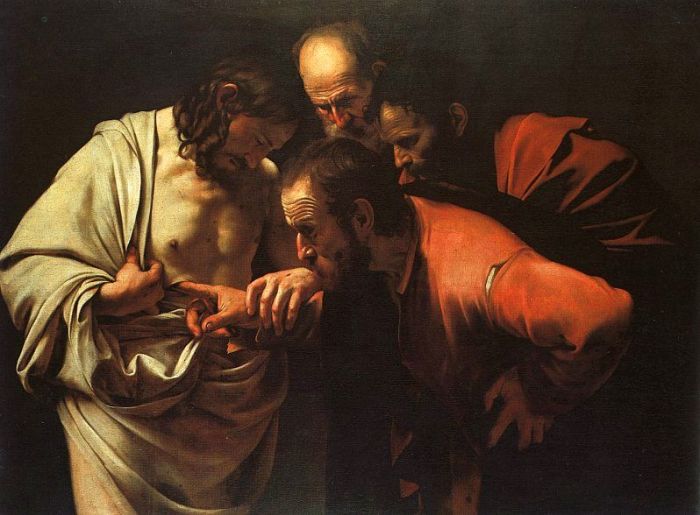
Image credit: The Incredulity of Saint Thomas, Caravaggio

John 20:19 On the evening of that day, the first day of the week, the doors being locked where the disciples were for fear of the Jews, Jesus came and stood among them and said to them, “Peace be with you.” 20 When he had said this, he showed them his hands and his side. Then the disciples were glad when they saw the Lord. 21 Jesus said to them again, “Peace be with you. As the Father has sent me, even so I am sending you.” 22 And when he had said this, he breathed on them and said to them, “Receive the Holy Spirit. 23 If you forgive the sins of any, they are forgiven them; if you withhold forgiveness from any, it is withheld.”

24 Now Thomas, one of the twelve, called the Twin, was not with them when Jesus came. 25 So the other disciples told him, “We have seen the Lord.” But he said to them, “Unless I see in his hands the mark of the nails, and place my finger into the mark of the nails, and place my hand into his side, I will never believe.”

26 Eight days later, his disciples were inside again, and Thomas was with them. Although the doors were locked, Jesus came and stood among them and said, “Peace be with you.” 27 Then he said to Thomas, “Put your finger here, and see my hands; and put out your hand, and place it in my side. Do not disbelieve, but believe.” 28 Thomas answered him, “My Lord and my God!” 29 Jesus said to him, “Have you believed because you have seen me? Blessed are those who have not seen and yet have believed.”

30 Now Jesus did many other signs in the presence of the disciples, which are not written in this book; 31 but these are written so that you may believe that Jesus is the Christ, the Son of God, and that by believing you may have life in his name.

The disciples do not see a ghost of Jesus. They do not see a hallucination, or a vision, or a dream of Jesus. They do not see a reanimated Jesus. Thomas does not put his hands into the side of a zombie.

They see, for the first time, what it is to be human. Jesus is what they will one day become, a human person with a glorified body over which death no longer has sway.

Make no mistake, John’s description of the locked doors in v. 19 is not here to make us think that this Jesus now exists on some ethereal plane where he can walk through walls. He has not transcended above the physical. But neither is he bound by what we think is physical. He is not, as the disciples are, chained indoors by fear, threats, or death. He has passed through all these things and come out alive. Neither is he stopped by the locked doors. His resurrected body is more realthan the doors, more physical than the physical. As he said, he is the Door. And the doors the disciples vainly lock are as ghosts to him.

He offers them peace – three times in this passage – because his body is the sign of their peace. Why should they fear the Jewish leaders? The Sanhedrin could do no worse to them that it did to Jesus. Yet, here is Jesus, standing in front of them, showing them his hands and his side. His wounds could no longer kill him; the scars stand eternal witness that it is finished. The peace has been bought for a price. God, the victor over sin and death, sends his very Spirit that he might be present with his friends. He has forgiven them their sins. And the disciples are now ambassadors of that forgiveness because they have seen in the flesh the cost of forgiveness.

But Thomas doubts. The other disciples doubted before when they did not believe the true testimony of a woman. Thomas needs to see. He needs more than to see; he needs to touch. He needs more than to touch; he needs to feel inside with his whole hand. And Jesus condescends to Thomas. Jesus condescends as he did when he washed Thomas’ feet. Jesus bends low, as he did when he left his throne of power to become a baby. Thomas does believe and makes one of the boldest confessions in the Gospels: “My Lord and my God!”

This Jesus is human. This Jesus is the God who created humans. This Jesus is the God who suffered death by humans so that humans would no longer suffer death.

And the signs of his wounds, as with the many signs in Scripture, are given so that we might believe. When you see someone come back from the dead, belief cannot be a mere assertion of facts. It cannot be a calculus of probability. It must be a way of living, a way of following, that leads to life in Jesus’ name. Indeed, it is a way of living that will lead the disciples out of their locked rooms so that others who have not seen – like us! – will believe and be blessed. Because the Resurrected God is not a god of the dead but of the living.

A Year of Worship: The Presentation of Our Lord

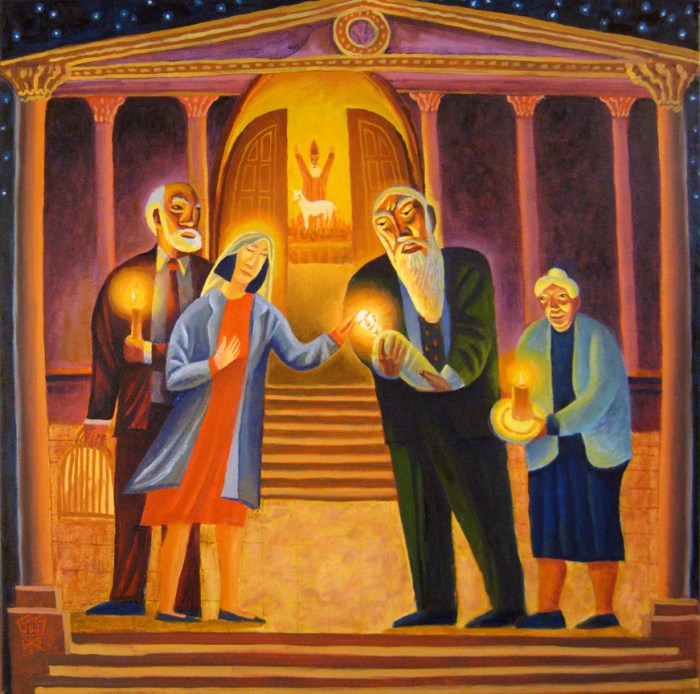
Image: The Presentation by James B. Janknegt

I confess that until today, my Christmas decorations were still up. This wasn’t intentional – there’s a newborn in our home after all. In the South, there’s a superstition about leaving your decorations up past New Years. By English tradition, Twelfth Night (Jan. 5th) is the proper time to de-decorate as it’s the night before Epiphany.

But in many parts of the Christian world, decorations are left up until February 2nd, exactly 40 days after Christmas. For many Christians, the “Feast of the Presentation of Our Lord” is the end of a whole Christmas & Epiphany season.

Forty days after his birth, as part of her worship, Mary brought Jesus to the temple. She was dedicating her firstborn son in obedience to Exodus 13:12-15 and making the sacrifices God commanded in Leviticus 12:1-4.

But this dedication was unlike the thousands of other dedications that had taken place there before. As Mary’s son, Jesus’ dedication was indeed in response to God sparing the firstborn of Israel when he passed over them in Egypt. But as God’s son, Jesus’ presentation at the temple was a foreshadowing of the cross. God spared the firstborn of Israel, but God’s love for Israel was so deep, he would not spare even his own firstborn son to redeem them!

The people who encountered Jesus that day knew that this was no ordinary dedication. This was the LORD God himself returning to his own temple. The prophetess Anna gave thanks because the Redeemer of Israel had arrived! Simeon, who had been told by the Holy Spirit that he would not “see death before he had seen the Lord’s Christ,” exclaimed, “My eyes have seen your salvation that you have prepared in the presence of all peoples, a light for revelation to the Gentiles, and for glory to your people Israel.”

Simeon’s proclamation of Jesus as the “light for revelation” for the whole world is reflected in the Christian tradition to bless candles during Feast of the Presentation services. This act led to another name for the day itself: “Candlemas.” The tradition highlights Christ’s light as one of the major themes of the Epiphany season, a season that begins with three Magi finding Jesus by following a star and ends with three disciples seeing Jesus transfigured before their eyes with bright rays of light.

Candlemas is a rare celebration among Cumberland Presbyterians. Nevertheless, it remains part of the ancient worship of the Church which proclaims Jesus as the Light of the World:

“The Mother of God, the most pure Virgin, carried the true light in her arms and brought him to those who lay in darkness. . . The light has come and has shone upon a world enveloped in shadows; the Dayspring from on high has visited us and given light to those who lived in darkness.” (Sophronius, Bishop of Jerusalem, AD 638)

Repenting in . . . Joy?

It’s easy for hard-corps Christians to get a little sanctimonious around the holidays. But for all of our preaching to “keep Christ in Christmas” (whatever that means) or all of our railings against the “commercialization” of the season, there is one biblical theme that a lot of the secular movies seem to “get” this time of year that Christians miss:

Joy follows repentance.

In our churches, we often confuse repentance with saying, “I’m sorry,” for long enough. The harder someone beats his brow, the longer someone wails against her sin, the more a teenager says things like, “I’m so broken!” – the more penitent and closer to God we think they are. But true repentance is deeper than the caricatures we make it. As Jesus warns in Matthew 6, it is not in looking gloomy or in disfiguring one’s face like a hypocrite that repentance is shown. Repentance is a turning – a turning away from self (even self-centered pity parties) and toward God.

And where there is God, there is joy.

Ebenezer Scrooge, after being haunted all night by ghosts, doesn’t emerge from his bedchamber on Christmas morning wailing about his sinfulness. He goes out, “light as a feather” and “merry as a school boy.” The Grinch doesn’t sulk on the side of Mt. Crumpit going on about how he deserves his frostbitten feet “ice-cold in the snow.” When his heart grows three sizes (an image of repentance not far off from Ezekiel 36:26!), the Grinch turns his sled around, blows his trumpet – and joins the feast. George Bailey, moments after realizing that is he is worth more alive than dead, doesn’t trudge back to his home in solemn regret. He runs and shouts, waking the sleepy town of Bedford Falls with cheer.

Notice that these examples do not subvert the seriousness of repentance. Ebenezer bears fruit in keeping with repentance by freely giving away his former idol – money. The Grinch returns every item he stole. George heads home to face stern consequences, including the possibilities of bankruptcy and prison. Like the Ninevites in the book of Jonah, there are times in the life of repentance when ashes are appropriate. What’s never appropriate is Jonah’s sulking anger as he watches God’s forgiveness in action.

Too often, we judge the repentance of others (and even ourselves) like the older brother of the prodigal son in Luke 15. We want other people – and even ourselves – to feel an “appropriate” level of guilt before they – before we – receive forgiveness. But this misses the fundamental teaching of Jesus to the Pharisees in the three parables of Luke 15: repentance is the joyful celebration of finding what was lost. Or as Ken Bailey puts it: “Repentance is the acceptance of being found.”

When we relegate repentance only to seasons like Lent (or only after the discovery of some grievous sin) we tend to forget the joy of repentance because we tend to make repentance about ourselves. And when we rush past Advent, we forget that our true joy at Christmas comes from a restored relationship with the Source of all joy. Yes, Advent is a season of repentance because it is our reminder that we turn toward God only because God has first turned toward us. Indeed, while we are still a long way off, he brings us in to a feast.

The Shepherd Prince

This is part of a series of sermon manuscripts I’ve preached while traveling to other churches. For more information, see the introduction to “Preaching the Blessed Gospel.”

Below is the manuscript of a sermon I preached on Christ the King Sunday, November 26, 2017, at West Point Presbyterian Church in West Point, GA, and Lebanon Presbyterian Church in rural Chambers County, AL. For more about these churches, click here.

As with all the manuscripts I post, the actual sermon varied in places. 


First Scripture Reading: Matthew 25:31-46

Sermon Text: Ezekiel 34:11-24


Jesus Christ is our Shepherd and our Prince. And that is truly good news.

We all know that we should live our lives in light of this truth. We all know that we are supposed to feed the hungry, give water to the thirsty, welcome the stranger and the foreigner, feed the naked, care for the sick, and visit the prisoner. Maybe we do some of these things well. But if you’re like me, our Gospel passage from Matthew this morning probably scares you more than it comforts you. If you’re like me, the words of Jesus in that passage probably shock you by exposing how selfish you really are – who I have neglected while I’ve been busy with my own wants cares and desires? Am I like the wicked, neglectful, and gluttonous shepherds Ezekiel condemns in our lesson for today?

The holidays certainly bring out some of the best and worst in us. The irony of what I’m about to say has been pointed out by many other people in many other places, but it’s worth saying again: on Thursday, we spent time being thankful for what we have already received; on Friday, we spent time knocking other people out of the way to get things we don’t need. But you don’t have to be a participant in “Black Friday” to get caught up in the consumption of the holidays! Some of us showed up to Thanksgiving without bringing a dish. Some of us who showed up to Thanksgiving without bringing a dish just sat around after the meal and let the same people who cooked do the dishes. Just about all of us ate more than we needed to on Thanksgiving. Some of us who skipped out on “Black Friday” shopping were still rude to people in the mall on Saturday. And most of us buying gifts for other people – if we’re really honest with ourselves – aren’t concerned so much with the person for whom we’re buying the gift as much as we’re concerned with the feeling we’ll have watching them open it. Some of us who skipped the shopping scene altogether were rude to our brothers and sisters in Christ yesterday – over an amateur football game. Almost all of us during the holidays are obsessed with consuming things, even at the expense of other people.

When I watch my son open presents at Christmas or his birthday, it’s kind of shocking to me the ways I’m actively teaching him to be dissatisfied and wanting more. Will opens one present. He’s overjoyed. He immediately starts playing with it – perfectly happy and content. But then I make him stop. I take away the toy he’s completely satisfied with . . . and I make him open another present.

The point I want to make isn’t to make you feel down about Thanksgiving or Christmas. I love this time of the year. But whether it’s November or December or any other month of the year, we are so obsessed with consuming, we are so dissatisfied with what we have, we are so concerned with ourselves and our feelings, that we neglect and harm other people in the process . . . people whom we are called to shepherd . . . even when – especially when – we sometimes think we are being thoughtful and selfless. It’s exactly when we are reaching out for that last toy we know will be adored by a child we love that we shove our neighbor out of the way.

In the garden, Eve offered the apple to Adam, thinking she was giving him a precious gift, but in doing so asked him to rebel against the Giver of all gifts. Adam, in a desire to escape the consequences of his own, free, sinful choice throws his wife under the bus by blaming her – and even blaming God. “The woman whom you gave to be with me, she gave me fruit of the tree, and I ate.” And for the consequences of their sin, all of creation fell into sin and death – from humans, to sheep, to grass, and even to the very ground.

God called a people out of that fall to be his own: a people who would follow in his ways, a people where God himself would be King. But these people, the sons and daughters of Jacob/Israel, didn’t want God as King. They wanted their own.

They did not even want God as their own. Time and time again they wanted to worship the things they created, idols made by their own hands, creations for their own consumption. The priests, their own leaders, looked after themselves – not the people. As the Lord says through Ezekiel earlier in chapter 34: “Ah, shepherds of Israel who have been feeding yourselves! Should not shepherds feed the sheep? You eat the fat, you clothe yourselves with the wool, you slaughter the fat ones, but you do not feed the sheep. The weak you have not strengthened, the sick you have not healed, the injured you have not bound up, the strayed you have not brought back, the lost you have not sought, and with force and harshness you have ruled them.

The shepherds led the people of Israel away by their selfishness. They valued their position, and the gains for themselves they could make from their position, more than they valued the sheep or even God. And that why the sheep were scattered into exile. That is why the Kingdom of Israel split into two. That is why the Northern Kingdom was conquered by Assyria over a hundred years before this passage was written. That is why Judah, the Southern Kingdom and the audience of Ezekiel’s prophecy, was conquered by Babylon and sent into exile away from the Promised Land. The shepherds did not tend for or care for the sheep.

But God refuses to give up. And verses 11 to 16 in our passage give us God’s solution. “Behold – Look, See, Pay Attention – I, I myself, will search for my sheep and I will seek them out.” The solution for Israel is not simply better shepherds. It is certainly not for the current shepherds to simply “do better.” The wrong way to read this passage – and even the passage from Matthew we read earlier – is to read it in purely moralistic terms.

You cannot seek out the lost who are scattered – only God can. You cannot bring light to darkness – only God can. You cannot gather people and bring them into God’s own land – only God can.  You cannot feed them with good pasture, or make them lie down, or bind up the injured, or strengthen the weak, or destroy the fat and the strong – only God can.

And indeed God has.

Jesus Christ is our Shepherd and our Prince. And that is truly good news.

God does not abandon humanity or his people but becomes one of us in Jesus Christ. Like the shepherd who loses the one sheep out of a hundred, or the woman who loses one coin out of ten, it is Christ who seeks you out – who seeks out all of his lost sheep – to bring you all into his care. God does not let his sheep thirst but makes the water clean that was muddied by the dirty hooves of selfish sheep. Then washes his own in that clean water, and those who drink of that water will never thirst again. God does not leave the starving sheep to the mercy of the bullying sheep but allows himself to be slaughtered – and then gives us his own body for our bread. God does not let the sick and the injured sheep to waste away and die. He offers them his own shed blood as ointment for their wounds and a cure for their sickness.

No, the cure for Israel, scattered in exile in Babylon is not just for the shepherds to “do better.” They need a Great Shepherd who lays down his life for the sheep.

Jesus Christ is our Shepherd. And that is truly good news.

It is easy for us to criticize them: the priests and kings and elders of Judah, the shepherds who have failed the sheep. But even as our Black Friday and holiday consumption shows us, we have trouble caring for the sheep – even within the church. It is easy for us to forget that verses 17-19, the judgement of the God here is on some of the people of God. God is not just judging the wicked shepherds but the sheep! These are sheep that are not satisfied with the good pasture God has given but tread down the rest of the pasture under foot. These are sheep that are not satisfied with God’s clean water but instead dirty the water with muddy hooves making undrinkable for everyone.

Is that what we do in the church?

How often do we understand our local congregations as flocks of sheep underneath the one Shepherd, Jesus? Or do we – as is the case all too often these days – understand our churches to be about us? Consumption in the church is a very real and very dangerous thing. I don’t know if you see it much here in this church – I’m sure you see it some – but I see it all the time in Birmingham. Anytime you do something someone doesn’t like – if a sermon rubs someone the wrong way, if you try to put up something “new” in the sanctuary, if you’re not doing some program aimed at this particular group, or if you make a change that affects that particular group – people threaten to leave the church! We look too often at Jesus coming to be our shepherd as Jesus coming to be my personal shepherd only. All I need is Jesus, my Bible, and me. Everything else is “man-made.” Everything else is “optional.”

Sisters and brothers, for those who are in Christ Jesus the Church is never optional. For the sheep gathered together by the great Shepherd, the flock is never optional. And care within the flock is not optional, either. The church cannot be a buffet style model where you take what you want, leave what you don’t, and go to some other restaurant down the street if you don’t like the menu. Because the fundamental, underlying attitude we often have about Church is that it’s all about me – my wants, my desires, my opinions, my needs being met.

And the truth of the gospel is that the Church is not about you – it’s about Jesus.

The Lord says through Ezekiel in verse 16 that he will feed the injured sheep with justice. The word here is just some abstract idea. It means the right ruling in a case, like a court decision. Too often in the church, in a desire to get what we want, we knock each other down and bully each other around. We, as verse 21 says, “push with side and shoulder and thrust the weak with horns.” We are so used to a culture that demands we get our way, that we do it within the church to the harm of the other sheep!

If you have been wronged by people within the Church, I am here to tell you today that God will feed you justice – that is, righteous judgment – to right your wrong.

And if you have wronged another in the Church, fear the judgment of God. Go and be reconciled with your sister or brother.

As I mentioned earlier, the wrong way to read this passage is a moralistic one. Israel did not need simply better shepherds or the shepherds to do better – they needed a New One . . . just as the Church needs Jesus Christ to be her Shepherd. But the other wrong way to read the passage is this – that the Shepherd is only for you. No, the Shepherd is for his whole flock, not just or even primarily you. The great privilege, joy, and satisfaction is that the flock includes you, and it includes me. But the flock is not about you or me.

And that is why the Shepherd must also be a Prince.

Jesus Christ is our Prince. And that is truly good news.

In the ancient world, one of the important duties of a king was to judge, and in judging the king would establish justice. Today is Christ the King Sunday. It is the end of the church worship year, and it is our reminder that Christ reigns over all creation, the entire universe, and especially the Church.

Our Prince establishes justice.

Our Shepherd feeds us.

The two go hand in hand with one another. But our Shepherd Prince is unlike all of the shepherds and all of the princes that have ever been a part of this world. He does not seek his own glory at the expense of his subjects or his sheep! For almost every prince that has ever lived, there have been certain functions of the prince that have benefited the people. But make no mistake – the people are there to serve the prince and never the other way around. For almost every shepherd that has ever lived, there have been certain duties of the shepherd that have benefited the sheep. But make no mistake – the sheep are to provide goods, wool and meat, for the shepherd.

Yet, our Prince knelt to wash our feet. And our Shepherd laid down his life for the sheep.

Jesus Christ is our Prince and our Shepherd. And that is truly good news. Amen.