Blog

The Five Solae: Sola Scriptura

“What is truth?”

In thinking of “fake news” over the past year, many of us have probably asked that ancient question – especially since we cannot agree on what even constitutes “fake news.” But when Pilate said these words to Jesus (John 18:38), he did not realize that he was staring at the Truth himself (14:6) – the Word of God made flesh (1:1-14) – the answer to his question. By his education, he had been trained to ask this question, a deeply human question, and to uncover the answer by dialogue and reason. He missed that the man he was about to hand over to be executed was God’s own demonstration for him of the Truth.

For Christians, Jesus Christ is the Truth of God in the flesh. But there was some disagreement at the time of the Reformation in how we approach or understand this Truth. Four years after Martin Luther mailed his Ninety-Five Theses to his archbishop, he was on trial. The pope himself had pronounced that there were errors in his writings, and several of them had been banned. At the Diet of Worms in 1721, Luther’s works were laid out on a table in front of him, and he was asked to recant. His famous reply:

Unless I am convinced by the testimony of the Scriptures or by clear reason (for I do not trust either in the pope or in councils alone, since it is well known that they have often erred and contradicted themselves), I am bound by the Scriptures I have quoted and my conscience is captive to the Word of God. I cannot and will not recant anything, since it is neither safe nor right to go against conscience. Here I stand, I can do no other. God help me. Amen.

For Luther, the only completely trustworthy way of knowing what’s true about the Truth – Jesus Christ – was through the Bible. This was the “formal” cause of the Reformation, the reason Luther thought that his teachings were justified. The ancient councils were important for understanding the Truth. The church was essential for coming to know the Truth. But the teachings of councils and the church must be measured against the teachings of Scripture.

Three hundred years after Luther, the founders of the Cumberland Presbyterian Church used Scripture as their justification for breaking away from the Presbyterian Church in the U.S.A.: “All church-power however exercised, is ministerial and declarative only; that is, the Holy Scriptures are the only infallible rule of faith and practice.” (Introduction to 1883 Confession) This is carried on in our current Confession when we say that the Bible is “the authoritative guide for Christian living” because “the authority of the scriptures is founded on the truth contained in them and the voice of God speaking through them.” (1.05-06) We do not interpret Scripture alone – we need the help of the church, other Christians, the ancient councils, and especially the illumination of the Holy Spirit – but when justified by the teaching of Scripture, we hold that even one person can help correct the whole church.
THE FIVE SOLAE: AN INTRODUCTION

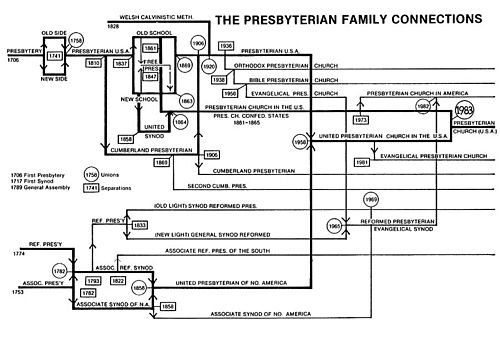
When I teach classes about the history of Presbyterianism in America, I like to use a chart that outlines the different denominations and when they were formed: the schisms, the occasional unifications, the schisms-within-schisms. It’s complex.

Presbyterian_Family_Connections

Someday, I’ll lay this chart out for Will, but I’ll have to wait for him to get over his fear of spider webs. There’s a great cartoon of a similar chart on a chalkboard in a classroom with the teacher saying: “So this is where our movement came along and finally got the Bible right.”

B7R9t.jpg

“Jesus is so lucky to have us.”

Almost five hundred years and somewhere around 30,000 new denominations later, we are still talking about what Martin Luther did on “All Hallows’ Eve” (the day before All Saints’ Day) in 1517. On the door of All Saints’ chapel at the University of Wittenburg, Luther posted a protest of the Church: “Disputation on the Power of Indulgences” or the “Ninety-Five Theses.”

The background to this event was complex, and the Reformation of the Church that swept Europe over the next 130 years was even more complex. But the predominant issue on Luther’s mind on that date was the sale of “indulgences.” The understanding of grace by the Church at the time was an incremental one. You received grace for your original sin and all of your other sins at baptism. Sins after baptism needed more grace, and you received this grace within the church through the seven sacraments – especially the regular sacraments of communion and confession. The Church taught that if you died with minor (or “venial”) sins, your soul had to be purified in Purgatory to make you holy enough to enter Heaven. But there was another way to “spring” your soul – or the soul of a loved one – out of Purgatory. You could buy an “indulgence,” and the Church would absolve the sin.

Luther objected to this as something not found in Holy Scripture. In 1521, he was excommunicated, but the shockwaves were already spreading throughout Europe. Indeed, they reverberate to Cumberland Presbyterians today. Luther’s protest within the Church became the Protestant Reformation.

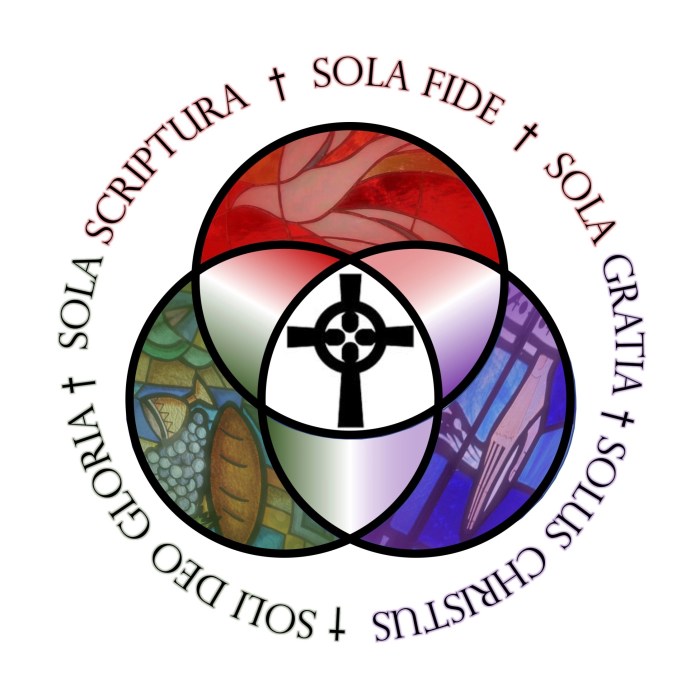
It is certainly right to mourn the schism of the last half-millennium, and we should, like Christ, desire the unity of the whole Church. Yet, it is also right for us to lovingly pursue the truth of the gospel as revealed in Holy Scripture. In trying to understand how we got here, Derek and I will be looking at the five summary statements, the “Five Solae,” for why Protestants broke away from the Roman Church. We will look at the “formal cause” – sola scriptura, Scripture alone – which was how Luther justified himself in protesting the teachings of the Church at all. And we will look at the content of his protest itself, that we are saved sola fide, sola gratia, solus Christus, soli Deo gloria –  through faith alone, by grace alone, in Christ alone, to the glory of God alone. May Christ bless his Church and help us to better understand his gospel. Amen.

Meditating on the Word

The spiritual discipline of meditating on Scripture can be intimidating. Why should we do it? What comes from it? How do we do it? How do I overcome the difficulties of meditation on Scripture? These are certainly four pressing questions to anyone who desires to dwell in the Word of God faithfully and hear God’s voice each day.

First things first. You do not need a bunch of books or education to begin meditating on Scripture. All you need to begin a daily routine of meditation on Scripture is time, a bible, and perhaps a journal. A final important aspect one will need for meditation on Scripture is a community to walk through God’s Word faithfully with you. This final component is neglected many times when we begin to meditate upon Scripture. However, it is of immense importance because it creates a relationship built upon a common reflection on God’s Word and it can help prevent faulty readings and interpretations of Scripture.

Bonhoeffer answered the four questions I listed above by sharing how he meditated upon Scripture and offered up prayers each day.

Bonhoeffer believed that Christians should meditate upon Scripture first and foremost because they are Christians. If we say we follow Jesus Christ, then it is imperative for us to know how Christ calls us to obedience. It is in Holy Scripture that we hear God’s will for our lives—how we are to love God and love others.

He also believed that we should expect transformation from our meditation on Scripture. As the people of God read and allow God’s Word to penetrate their souls, they understand the reality of Christ living within them. When we meet with Christ each day before we meet others in the world, we will be strengthened by the grace of Christ for what we will experience.

The final two questions help us to understand how we are to go about meditating upon Scripture. Bonhoeffer believed that the Christian should be concerned with the quality of their time with Scripture over the sheer quantity of reading a text. For Bonhoeffer, a Christian should spend an entire week meditating upon the same ten to fifteen verses of Scripture for at least thirty minutes a day. This repetition may not make sense to us, but for Bonhoeffer, when we allow our hearts to meditate upon the individual words of a small set of verses, then we would be more aware of their power and meaning for our lives. One may begin to feel their heart or mind wander as they meditate upon those texts, but we should engage that wandering and allow it to be the fertile ground for our prayer life. We may perceive that our wandering mind is a problem—but it is not a problem. It is the occasion for prayer. As you read and ponder a text, a family member or a friend may appear in our mind. We must take that opportunity to pray specifically for them as we meditate upon the text. Through this discipline, we are understanding the grace of God and seeking it for our lives and the lives of others.

Most importantly, be patient and faithful in your meditation. One may believe that thirty minutes is too much time to devote to such an exercise, but as we all know, time in God’s word is never a waste. Don’t let the frustrations of life cause you to miss hearing the life-giving word of life that we have through Jesus Christ. Amen.

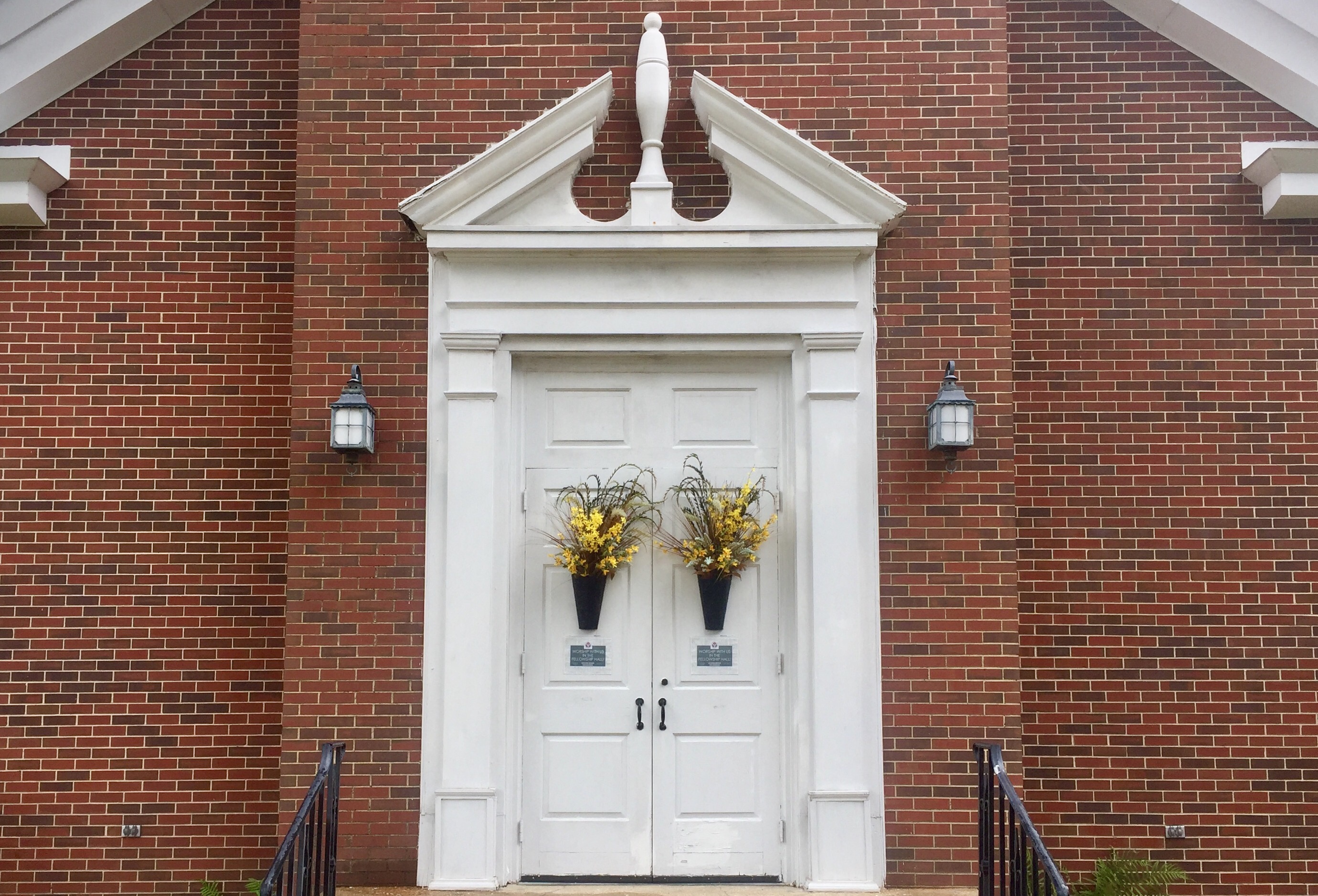
Sacred Spaces: The Doors

“So Jesus again said to them, ‘Truly, truly, I say to you, I am the door of the sheep. All who came before me are thieves and robbers, but the sheep did not listen to them. I am the door. If anyone enters by me, they will be saved and will go in and out and find pasture. The thief comes only to steal and kill and destroy. I came that they may have life and have it abundantly. I am the good shepherd. The good shepherd lays down his life for the sheep.’” John 10:7-11 (ESV)

Every church sanctuary points us to Jesus. The sanctuary is not just another building for just another group of people to gather because of their shared interests. It is a holy place. It is a place that is radically different from what the world offers. It is a place where people gather to worship and proclaim Jesus Christ.

This can be confusing since sanctuaries often share similar features to other buildings we enter. That is not a reason for us to consider the activity of the church to be equal to that of other activities that take place every day. It is always helpful to remember that though the Church is not a building but a people, the church building serves a sacred purpose for the strengthening of the people of God for the mission of God in our world.

In John 10, Jesus proclaims that he is the door to eternal life. As we enter through the doors of our sanctuary, we should be reminded that it is only in Christ alone, through Christ alone, and for Christ alone that we have peace with God. The doors of the church are a proclamation and invitation to those in our community to come and see that the Lord is good. The doors are open for all to hear the Gospel call of Christ to salvation. That is why it is problematic when the church closes its doors to people who are lost and in need of being found. It is a true scandal when the church shuts out men and women who are weary and heavy laden by the demands of this world because Jesus is clear in his invitation to all those burdened souls to come to him and experience rest (Matthew 11:28).

The doors at Homewood CPC should be a blessed sight in our community. They should be emblematic of the refuge we have in Christ. They should shout to the world Jesus’s proclamation that even though in this world we will have trouble, we must take heart because he has overcome the world (John 16:33). The doors of the church remind us that the mission of God never rests. Even during times of prosperity and relative comfort, the doors of the church emphasize the importance of God’s people remaining awake and not lulled into the coma of comfort. The doors of the church help us hear the words of Jesus time and time again that salvation is available to all. When we forget this, we are exactly who Jesus talks about—those who are thieves stealing, killing, and destroying the very message we’ve been entrusted with to share so freely.

May we always receive the rest of Christ when we see the doors of the church, but may we never slumber in that rest. May we always be pointing people to Jesus wherever God has placed us so that to those who need to hear the Gospel will always know the door to enter. Jesus is that door to life abundant. Amen.

SACRED SPACES: THE NARTHEX

“Therefore, brothers and sisters, since we have confidence to enter the holy places by the blood of Jesus, by the new and living way that he opened for us through the curtain, that is, through his flesh, and since we have a great priest over the house of God, let us draw near with a true heart in full assurance of faith, with our hearts sprinkled clean from an evil conscience and our bodies washed with pure water.” (Hebrews 10:19-22)

For the people of the living God, the entrance to the house of worship has always been a place of repentance and welcome, holiness and grace. The narthex is the reminder to worshipers that God is holy – completely other, distinct from creation, without sin. At the same time, it is the reminder to us that this God passionately desires intimacy with his children.

There is holy tension in this place.

It is not the unnecessary tension created by so many churches whereby the stranger wonders whether or not she will be welcomed. If you’ve ever visited a new church, you’ve likely felt this negative tension. From the car to the stairs and through the first doors, there is an anxious moment: “Will I be welcome here?” The norms of any community are intimidating to the foreigner. But when those norms are manufactured into a facade of “holiness,” even the penitent can find themselves locked outside the gate.

No, this is the necessary tension of Isaiah in the heavenly throne room. It is the tension of a man crying out, “Woe to me! I am ruined! For I am a man of unclean lips, and I live among a people of unclean lips, and my eyes have seen the King, the LORD Almighty” and that man hearing the relief of the response of grace: “Your guilt is taken away and your sin atoned for.” (Isaiah 6:5,7) It is the tension that’s fulfilled Christ. The curtains of the tabernacle and temple did not protect the children of Israel from God, but from themselves. Sinfulness cannot survive the light of a holy God – “for the wages of sin is death.” (Romans 6:23)

“But the free gift from God is eternal life in Jesus Christ our Lord.” (also Romans 6:23) In Christ, “for our sake he made him to be sin who knew no sin, so that in him we might become the righteousness of God.” (2 Corinthians 5:21) The curtain is torn in two, drawing us into fellowship with God – and the curtain torn is God’s own body broken for us. The blood that consecrates us for the worship of a holy God is not the blood of bulls and rams but God’s own blood shed for us.

For Christians, no building is a temple. In Christ, sinful creatures have been made the temple of a holy God. The entry to our place of assembly is a reminder of this holy tension. And “with full assurance of faith” we draw near to God because God has first drawn near to us. Amen.

SACRED SPACES: THE OFFERING PLATE

God does not need your money.

“The God who made the world and everything in it, being Lord of heaven and earth, does not live in temples made by man, nor is he served by human hands, as though he needed anything, since he himself gives to all mankind life and breath and everything.” (Acts 17:24-25)

I confess that, too often, I think God is somehow grateful for what I give. I know the church needs material contributions to keep things going. And, even though I don’t consciously think it, I often have this “you’re welcome” feeling stirred up when I drop my check into the offering plate. It’s the same kind of feeling I get when I round up my purchase at the grocery store for a charity or give some change to someone on the street. My sin is that I reverse the roles of who is dependent on whom. I think of my giving as a transaction, just like any other transaction I make in the world, and the one who receives my money should be grateful for it.

Giving to the church is a good, biblical, and – when done in faith in Christ – a righteous act. But if you give out of compulsion (2 Corinthians 9:7), or give out of the need for praise (Matthew 6:2-4), or because you think God needs it – this is not Christian giving! “‘What to me is the multitude of your sacrifices?’ says the LORD” (Isaiah 1:11). This is why the Bible, and especially the New Testament, is so concerned with the attitude of the giver: “Each one must give as he has decided in his heart, not reluctantly or under compulsion, for God loves a cheerful giver” (1 Corinthians 9:7).

If these were proper Christian attitudes of giving, the church should not make a point to pass around an offering plate in worship! In 2017, there are more efficient ways of collecting money. In a culture that looks with great suspicion on any pastor with a new car or on any church with a “Christian Life Center,” there are more discreet, less provocative ways of asking for money. The offering plate, especially in worship, especially when passed around in the middle of worship, is extremely presumptuous if we think about Christian giving in worldly, transactional terms.

No, we pass the offering plate in worship because it is our reminder that everything we have, everything we are, everything we give, and everything we take belongs to God already. There is no distinction. The tithes are God’s. The offerings are God’s. The giver is God’s – “You are not your own, for you were bought with a price” (1 Corinthians 6:20). The offering plate is a worshipful reminder of what is God’s, not what is ours. Like the cross, like the table, it is the reminder that your old self has died with Christ and your new self belongs to him completely.

We give freely because in Christ we have been given freely. Amen.

Sacred Spaces: The Baptismal Font

I love walking into the home of a friend or family member and receiving the welcoming embrace of a hug accompanied by the words “make yourself at home!” A warm welcome is a powerful sign of acceptance, security, and rest. It leads us into fellowship and communion. Oh, how our world could use a warm welcome right now!

September 14 will mark the beginning of my eighth year as senior pastor of Homewood CPC. The warm welcome my family and I received those eight short years ago still resounds in my heart and mind. It is that welcome that created for me and my family the foundation for ministry at HCPC.

Easter of this year, Sherrad and I decided to move the baptismal font to the back of the sanctuary to welcome each person as they entered in for worship. As worshippers entered, they were encouraged to touch the water and make the sign of the cross upon their foreheads in order to remember their baptism. It’s place at the back of the sanctuary also served as a reminder that we had all passed through the waters of baptism into the family of God’s people from all times and places. You see, the baptismal font is like that warm welcome we receive when we enter a friend or family member’s home. In our baptism, we are claimed by God. We are welcomed into his family. We receive from him the assurance of his faithfulness. God welcomes us in and invites us to make ourselves at home within his fellowship with our brothers and sisters.

When we see the baptismal font, let us not just see something that is used only during times of baptism, but as a constant reminder of our welcoming and hospitable God who has claimed us in baptism. May we be reminded of the longing within our souls that pleads to be set free from a world of chaos in order to reside in the eternal presence of God. May we remember the words of Hughes Oliphant Old who said that baptism in the name of the Father, the Son, and the Holy Spirit hopes that all people will be received into the household of faith, joined to Christ in his death and resurrection, and be filled with the gift of the Holy Spirit. Amen.

Sacred Spaces: The Wooden Pews

Our good friend Adam Borneman recently introduced me to a podcast entitled Strangely Warmed on the Crackers and Grape Juice website. A recent episode included a discussion of the lectionaries readings for the 12th Sunday after Pentecost. Intriguing stuff, I know, but this was a timely episode for me as I have been wrestling with how to write about how wooden pews remind us of the Gospel of Christ.

Full disclosure—I have never overheard anyone ever gleefully rejoice in getting to sit in a wooden pew for an hour on Sunday. Instead, I’m pretty sure that several of our choir members joined the choir so they wouldn’t have to sit on wooden pews. They have luxurious, padded chairs in the choir loft, y’all! Nevertheless, the wooden pew communicates an important truth about God’s salvation in Jesus. In 1 Peter 3:18-22, Peter describes our salvation in Christ by reminding us of Noah and his ark. “They formerly did not obey, when God’s patience waited in the days of Noah, while the ark was being prepared, in which a few, that is, eight persons, were brought safely through water. Baptism, which corresponds to this, now saves you, not as a removal of dirt from the body but as an appeal to God for a good conscience, through the resurrection of Jesus Christ (1 Peter 3:20-21).” God brought his people safely through the waters in the ark. A wooden structure to get us safely through life.

This brings me to Borneman’s recommendation of the podcast mentioned above. This particular episode was about the story of Moses in Exodus 1:8-2:10. I quickly realized as I listened to the podcast that I had missed something incredible about the birth and rescue of baby Moses. When Moses was born, his mother made a basket of bulrushes, or reeds, daubed it in bitumen and pitch, and placed him in the river so that he would survive Pharaoh’s edict requiring all Hebrew newborn baby boys to be thrown into the Nile to die. Moses’s mother courageously constructs a tiny ark to save her child. Pharaoh’s daughter then finds baby boy, takes him as her own, and names him Moses, which means “drawn out of water”. Rev. Drew Colby on the podcast then proceeded to blow my mind as he connected some dots that I am ashamed to not have connected myself. He connects the ark of Noah, the tiny little baby basket boat of Moses, the manger of Jesus, and the Church of Jesus Christ as the vessels that God places his children into in order for them to be brought through the chaotic waters of life into the eternal presence of his Kingdom! Mind. Blown.

How excited should we be to enter the sanctuary each Sunday and take our seat within a wooden pew next to brothers and sister in Christ and direct our attention to the Gospel proclaimed from the wooden pulpit? How overwhelmed should we be to know we were drawn from the waters of a wooden baptismal font? How thankful should we be when we eat bread and drink wine from atop a wooden table? Brothers and sisters, when we experience these realities, we are experiencing the same type of providence and loving-kindness that Noah, Moses, Jesus, and all the other people of the Gospel promise that has come from being grafted into the family of God. Let us never neglect the blessing of joining together with the communion of saints and truly rejoice! All praise, glory, and honor to our God who saves us from the chaotic waters of life! Amen.

Sacred Spaces: The Hymnals

This reflection is dedicated to the Glory of God and in honor of Robert Turnage.

The assembly of the Lord God sings.

She sings the glory of God’s creation – like the stars at the foundation of the world. (Job 38:7) She sings with thankfulness for the works God has done for her and on her behalf – like Moses when God delivered Israel from slavery in Egypt. (Exodus 15:1-22) She sings in her distresses, clinging to the only true hope found in her God – like David when he was in the “dust of death.” (Psalm 22) She sings praises to God even in the midst death because of God’s own assurance that death has been overcome – like Jonah from the belly of the fish. (Jonah 2) She sings because God has come to us in the flesh to sing with us – like Mary when she was visited by the angel. (Luke 15:46-55) She sings eternally the glories of the Christ who died and was raised for her:

Worthy is the Lamb who was slain,

to receive power and wealth and wisdom and might

and honor and glory and blessing! (Revelation 5:12)

In the midst of Nazi oppression, oppression that would later claim his life, Dietrich Bonhoeffer wrote: “God has prepared for Himself one great song of praise throughout eternity, and those who enter the community of God join this song.” (Life Together) The song is God’s, not our own. The song began before we were knit together in our mothers’ wombs. If the Lord tarries, it will continue long after our children’s children are dead, buried, and raised again. But through the mysterious working of God, we join in the eternal, hopeful song of God here and know.

When we stand in our sanctuary, grasp our hymnals in our hands, and sing words from Scripture arranged by the saints who came before us, we join in a miracle. With each verse, we sing with a new song in new circumstances the ancient mystery of God’s intimacy with us. It was the miracle I joined as preschooler (one of my first memories of worship) when I joined in the singing of our Methodist congregation – even though I did not fully know the words or was able to read a single one of them. It is the miracle my son, a preschooler, joins when he sings, “Jesus loves me, this I know…”

It is the miracle of the eternal God that was sung by my friend, Robert, when his soaring tenor voice pierced through the thick liturgy of my ordination service on Holy Saturday to proclaim that even in the depths of our distresses (Jesus was in the tomb!) God’s song continues forever. It continues for his glory. It continues for us. And we sing with God.

“Comfort ye, my people,” saith your God.

Speak ye comfortably to Jerusalem

And cry unto her, that her warfare is accomplish’d,

That her iniquity is pardon’d.

The crooked straight, and the rough places plain.

The Importance of Sunday School (or Awesome Sauce Life Group)

It's back to school time! As teachers and students begin a new  school year, we all get a reminder of the joys of learning, friendship, and early bedtimes. I am grateful that my three kids are much more successful at making friends than I was when I was their age. Ava, Braden, and Drew were happy to go to school today in large part because of their friendships and the value they see in what they learn in school. It is amazing how elementary school children understand, in their own ways, of course, relationships and the value of what they are learning. What's more amazing is how we adults forget both of those aspects as we live our lives.

Since its back to school time, I was pondering the importance of Sunday school to my life as a pastor. I know that, in general,  over the last few years, Sunday school has fallen out of fashion in favor of "life groups", "small groups", "home groups", or other inspiring groupings of people. Be it Sunday school or "awesome sauce life group", the purpose remains hopefully the same–a faith community for people to gather around the Word of God in order to deepen relationships with one another and understand the eternal truth of Jesus Christ. This is called discipleship. Usually people will stop attending Sunday school if it doesn't provide meaningful, Christ-centered relationships or if it doesn't contribute any type of meaning or purpose to our lives. When this occurs, it is a mournful thing because the community of Christ should be built around the relationships that God has knit together focused upon the testimony of God for us in our world. We need each other more than we realize.

Dietrich Bonhoeffer believed heavily in Christian community. For him, it was not a social club. It was not an activity group. It was not something to be attended to whenever we felt like we should. It was communion. It's purposes were plenty, but central to this purpose was the presence of Christ. Jesus says in Matthew 18:20, "For where two or three are gathered in my name, I am there among them." What an incredible promise! Sadly, this is a promise that never gets experienced by so many in our churches. Bonhoeffer tells us in his classic Life Together,

"God has put this word (the Gospel) in the mouth of men in order that it be communicated to other men. When one person is struck by the Word, he speaks it to others. God has willed that we should seek and find His living Word in the witness of a brother, in the mouth of man. Therefore, the Christian needs another Christian who speaks God's Word to him. He needs him again and again when he becomes uncertain and discouraged, for by himself he cannot help himself without belying the truth. He needs his brother man as a bearer and proclaimer of the divine word of salvation. He needs his brother solely because of Jesus Christ. The Christ in his own heart is weaker than the Christ in the word of his brother; his own heart is uncertain, his brother's is sure."

Sunday school (or Awesome Sauce LG) provides us with the opportunity to come together as brothers and sisters who are navigating through life clinging to Christ and needing to hear that someone else is trodding that same path with us. In our discipleship we can encourage one another, rejoice together, pray together, mourn together, work together, sing together, and commune together. And with this communion in the name of Christ, we get Jesus. 

So, may we always understand the importance of our relationships and the value of our fellowship each week as we meet together for worship and discipleship. For when we gather each Sunday, Christ is present with us and nourishes us for the lives we've been called to live. Amen.