Blog

Lent with Bonhoeffer: The Welcome of Christ

Life Together Header

Shrove Tuesday, February 13, 2018

“Now concerning love of the brothers and sisters, you do not need to have anyone write to you, for you yourselves have been taught by God to love one another…But we urge you, beloved, to do so more and more.”  1 Thessalonians 4:9

It is God’s own understanding to teach such love. All that human beings can add is to remember this divine instruction and the exhortation to excel in it more and more. When God had mercy on us, when God revealed Jesus Christ to us as our brother, when God won our hearts by God’s own love, our instruction in Christian love began at the same time. When God was merciful to us, we learned to be merciful with one another. When we received forgiveness instead of judgment, we too were made ready to forgive each other. What God did to us, we then owed to others. The more we received, the more we were able to give; and the more meager our love for one another, the less we were living by God’s mercy and love. Thus God taught us to encounter one another as God encountered us in Christ. “Welcome one another, therefore, just as Christ has welcomed you, for the glory of God.” (Romans 15:7)

-from Life Together, pgs. 33-34

(These reflections from Dietrich Bonhoeffer can be found in a collection entitled A Year with Dietrich Bonhoeffer: Daily Meditations from His Letters, Writings, and Sermons. It can be purchased HERE.)


A Year of Worship: The Presentation of Our Lord

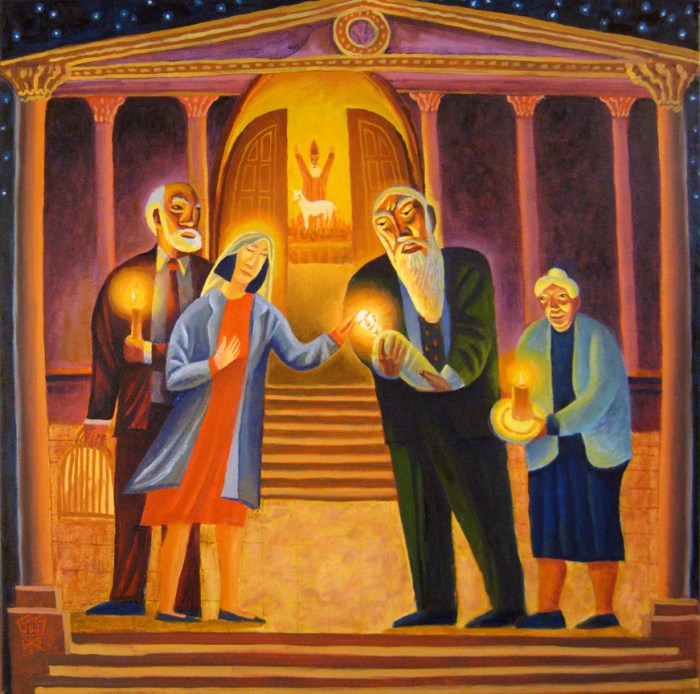
Image: The Presentation by James B. Janknegt

I confess that until today, my Christmas decorations were still up. This wasn’t intentional – there’s a newborn in our home after all. In the South, there’s a superstition about leaving your decorations up past New Years. By English tradition, Twelfth Night (Jan. 5th) is the proper time to de-decorate as it’s the night before Epiphany.

But in many parts of the Christian world, decorations are left up until February 2nd, exactly 40 days after Christmas. For many Christians, the “Feast of the Presentation of Our Lord” is the end of a whole Christmas & Epiphany season.

Forty days after his birth, as part of her worship, Mary brought Jesus to the temple. She was dedicating her firstborn son in obedience to Exodus 13:12-15 and making the sacrifices God commanded in Leviticus 12:1-4.

But this dedication was unlike the thousands of other dedications that had taken place there before. As Mary’s son, Jesus’ dedication was indeed in response to God sparing the firstborn of Israel when he passed over them in Egypt. But as God’s son, Jesus’ presentation at the temple was a foreshadowing of the cross. God spared the firstborn of Israel, but God’s love for Israel was so deep, he would not spare even his own firstborn son to redeem them!

The people who encountered Jesus that day knew that this was no ordinary dedication. This was the LORD God himself returning to his own temple. The prophetess Anna gave thanks because the Redeemer of Israel had arrived! Simeon, who had been told by the Holy Spirit that he would not “see death before he had seen the Lord’s Christ,” exclaimed, “My eyes have seen your salvation that you have prepared in the presence of all peoples, a light for revelation to the Gentiles, and for glory to your people Israel.”

Simeon’s proclamation of Jesus as the “light for revelation” for the whole world is reflected in the Christian tradition to bless candles during Feast of the Presentation services. This act led to another name for the day itself: “Candlemas.” The tradition highlights Christ’s light as one of the major themes of the Epiphany season, a season that begins with three Magi finding Jesus by following a star and ends with three disciples seeing Jesus transfigured before their eyes with bright rays of light.

Candlemas is a rare celebration among Cumberland Presbyterians. Nevertheless, it remains part of the ancient worship of the Church which proclaims Jesus as the Light of the World:

“The Mother of God, the most pure Virgin, carried the true light in her arms and brought him to those who lay in darkness. . . The light has come and has shone upon a world enveloped in shadows; the Dayspring from on high has visited us and given light to those who lived in darkness.” (Sophronius, Bishop of Jerusalem, AD 638)

The Angst and Peace of the Psalms

The Psalms reveal to us how we are to pray and how God answers our prayers.

The prayer book of the Bible contains the requests and praises from God’s people as they travel the road of life. As we encounter the Psalms, we become aware of the joys and tumults of life—things that open the mouths of God’s people to praise him as well as things that open those same mouths in lament and frustration. The Psalms stand as the open invitation to all to call upon the Lord with raw reality and unfettered hope.

One of the most difficult things for some to do is pray. What should we say to God and how should we say it to him? The Psalms give us a beautiful testament to the freedom we have in our approach to God. Furthermore, the Psalms show us that even during the angst we have in our lives, the peace of God in Christ is always present with us.

Take for example Psalm 69. The psalmist David begins his plea to God with what sounds like hopelessness. He is in danger of drowning. He is weary. His throat is parched. His eyes grow dim. This all happens as he waits for God to save him. David’s situation doesn’t relent. He is aware of the multitude of his enemies and how they attack him to destroy him. He recounts his weeping and humility. He even asserts his consuming zeal to serve the Lord. In all theses situations, his spirit is filled with uncertainty and angst.

Does this sound familiar to you? Do life’s anxieties, pains, and sufferings cause you to question the presence of God in your life? Do you sometimes feel as if your prayers during these trials are going unheard? Do you ever wonder what the point is to pray if God doesn’t seem interested in giving you an answer, a hope, or salvation? All of this can be compounded when we are doing our best to be faithful and obedient to God and his call on our lives.

If we were to stop here, we would certainly be overcome by our angst. But in this same Psalm, we see David grapple with his angst and not stop until peace prevails. The peace of God resounds throughout the Psalm. As David seems to be filled with despair, his constant cry to God is filled with reminders of God’s faithfulness and steadfast love. God is the only one who can deliver him from his tribulation. He looks to no other for his rescue. As the Psalm ends, David is filled with the assurance of God’s power and ability to rescue him. At one point, he cries, “But I am afflicted and in pain; let your salvation, O God, set me on high!” Ultimately, in the throes of affliction and with the hope of salvation, David rejoices and worships God for his mighty strength to save. God has given David his word and David trusts in that word regardless of his situation.

In our celebration of the birth of Christ, we must remember that God has given us his Word in the flesh. As we live, we have the hope, love, joy, and peace that can only be given by Christ. May we not neglect to keep our eyes upon Christ no matter how dire our situations. We will have times when we are under attack and seemingly ignored by God. But remember, we are never ignored by God. Jesus is the proof that God is always with us. He took on flesh and encountered the very enemies and angst that we battle. He defeated these threats and gives us his peace. So, as we end one year and begin another, may we never give into our angst and instead embrace the peace we have in Christ Jesus our Lord. “For God will save Zion and build up the cities of Judah, and people shall dwell there and possess it; the offspring of his servants shall inherit it, and those who love his name shall dwell in it.” In the name of the Father, the Son, and the Holy Spirit. Amen.

Advent Sandals

“Take off your sandals from your feet, for the place where you are standing is holy.” (Joshua 5:15)

My friend Tal has a long-standing tradition of refusing to listen to the song “Christmas Shoes”. He measures the greatness of the Christmas season by whether he has had to endure listening to the song. It is quite humorous seeing Tal take precautions and setting up his guard against hearing it. (I have heeded my brother’s warning about this song and I myself have avoided it.)

The scene in Joshua 5 when Joshua stands before the Commander of the LORD’s Army is a familiar scene. Joshua is told to remove his sandals because he is on holy ground. In Exodus 3:5, the same words are uttered by God in the burning bush to Moses as Moses is being commissioned to go announce freedom to the Hebrew slaves in Egypt. One other mention of sandals in the Bible is intriguing. In Mark 1:7, John the Baptist announces that he is preparing the way for one “mightier than he, the strap of whose sandals I am not worthy to stoop down and untie”. When we see sandals mentioned in the Bible, it appears, at least in these three accounts, that God calls people to humbly and reverently be about His mission on earth.

Moses, Joshua, and John. Men called by God to declare His mission on earth. What strikes me about the encounter with the Commander of the LORD’s Army in Joshua 5 is that Joshua is preparing to lead God’s people, the Hebrews, into the promised land. One would think God was mightily on their side, right? But when Joshua asks this Commander whose side he’s on, either Joshua’s side or the side of their opponents, this Commander responds with a resounding, “NO!” This Commander was not on either side of the conflict between men. The Commander’s loyalty was to God. Joshua’s response, along with Moses’s response and John’s response to this truth was a response of faithful worship. They realized very quickly that they should never ask if God is on their side, but instead, “Am I on the side of God?”

Advent is a season where the people of God should reflect upon that question. We just endured a contentious special election in Alabama and I believe that many people wanted their vote to reflect God’s will. The conversations I heard among faithful Christians seemed to echo concern about choosing the correct candidate because we did not want to vote for the candidate that God had not chosen. Advent is when we take time to reset and remember—Christ is King. Our loyalty as Christians is first and foremost to him. We should be a reflective people who take time to discern whose side we are on. Ephesians tells us that we do not wrestle against flesh and blood but against spiritual forces of evil in the heavenly places.

In other words, we cannot just assume that because we as Christian individuals assume the right course of action is the actual right course of action. Humility, sobriety, and discernment are essential to obedience. The true question for us as believers isn’t, “God, are you on our side?”. Rather, it isn’t a question at all. It is a plea–“Have mercy on me, O God, for I am a sinner. Create in me a clean heart and renew the right spirit within me!”

All of this is to remind us about who we are as Christians. As Tal avoids at all costs the “threat” of listening to the song “Christmas Shoes”, we should avoid at all costs false understandings of who Christ is. Christ is God for us. He has made it possible for us to be at peace with God. So, as we are on mission for God, I pray that we remember the message of the Advent Sandals. Humility, reverence, and service for the glory of God is our task. May we prepare the way for the return of our Lord, Jesus Christ, the Commander of the LORD’s Army. “Take off your sandals, you are on holy ground.” Amen.

Repenting in . . . Joy?

It’s easy for hard-corps Christians to get a little sanctimonious around the holidays. But for all of our preaching to “keep Christ in Christmas” (whatever that means) or all of our railings against the “commercialization” of the season, there is one biblical theme that a lot of the secular movies seem to “get” this time of year that Christians miss:

Joy follows repentance.

In our churches, we often confuse repentance with saying, “I’m sorry,” for long enough. The harder someone beats his brow, the longer someone wails against her sin, the more a teenager says things like, “I’m so broken!” – the more penitent and closer to God we think they are. But true repentance is deeper than the caricatures we make it. As Jesus warns in Matthew 6, it is not in looking gloomy or in disfiguring one’s face like a hypocrite that repentance is shown. Repentance is a turning – a turning away from self (even self-centered pity parties) and toward God.

And where there is God, there is joy.

Ebenezer Scrooge, after being haunted all night by ghosts, doesn’t emerge from his bedchamber on Christmas morning wailing about his sinfulness. He goes out, “light as a feather” and “merry as a school boy.” The Grinch doesn’t sulk on the side of Mt. Crumpit going on about how he deserves his frostbitten feet “ice-cold in the snow.” When his heart grows three sizes (an image of repentance not far off from Ezekiel 36:26!), the Grinch turns his sled around, blows his trumpet – and joins the feast. George Bailey, moments after realizing that is he is worth more alive than dead, doesn’t trudge back to his home in solemn regret. He runs and shouts, waking the sleepy town of Bedford Falls with cheer.

Notice that these examples do not subvert the seriousness of repentance. Ebenezer bears fruit in keeping with repentance by freely giving away his former idol – money. The Grinch returns every item he stole. George heads home to face stern consequences, including the possibilities of bankruptcy and prison. Like the Ninevites in the book of Jonah, there are times in the life of repentance when ashes are appropriate. What’s never appropriate is Jonah’s sulking anger as he watches God’s forgiveness in action.

Too often, we judge the repentance of others (and even ourselves) like the older brother of the prodigal son in Luke 15. We want other people – and even ourselves – to feel an “appropriate” level of guilt before they – before we – receive forgiveness. But this misses the fundamental teaching of Jesus to the Pharisees in the three parables of Luke 15: repentance is the joyful celebration of finding what was lost. Or as Ken Bailey puts it: “Repentance is the acceptance of being found.”

When we relegate repentance only to seasons like Lent (or only after the discovery of some grievous sin) we tend to forget the joy of repentance because we tend to make repentance about ourselves. And when we rush past Advent, we forget that our true joy at Christmas comes from a restored relationship with the Source of all joy. Yes, Advent is a season of repentance because it is our reminder that we turn toward God only because God has first turned toward us. Indeed, while we are still a long way off, he brings us in to a feast.

The Shepherd Prince

This is part of a series of sermon manuscripts I’ve preached while traveling to other churches. For more information, see the introduction to “Preaching the Blessed Gospel.”

Below is the manuscript of a sermon I preached on Christ the King Sunday, November 26, 2017, at West Point Presbyterian Church in West Point, GA, and Lebanon Presbyterian Church in rural Chambers County, AL. For more about these churches, click here.

As with all the manuscripts I post, the actual sermon varied in places. 


First Scripture Reading: Matthew 25:31-46

Sermon Text: Ezekiel 34:11-24


Jesus Christ is our Shepherd and our Prince. And that is truly good news.

We all know that we should live our lives in light of this truth. We all know that we are supposed to feed the hungry, give water to the thirsty, welcome the stranger and the foreigner, feed the naked, care for the sick, and visit the prisoner. Maybe we do some of these things well. But if you’re like me, our Gospel passage from Matthew this morning probably scares you more than it comforts you. If you’re like me, the words of Jesus in that passage probably shock you by exposing how selfish you really are – who I have neglected while I’ve been busy with my own wants cares and desires? Am I like the wicked, neglectful, and gluttonous shepherds Ezekiel condemns in our lesson for today?

The holidays certainly bring out some of the best and worst in us. The irony of what I’m about to say has been pointed out by many other people in many other places, but it’s worth saying again: on Thursday, we spent time being thankful for what we have already received; on Friday, we spent time knocking other people out of the way to get things we don’t need. But you don’t have to be a participant in “Black Friday” to get caught up in the consumption of the holidays! Some of us showed up to Thanksgiving without bringing a dish. Some of us who showed up to Thanksgiving without bringing a dish just sat around after the meal and let the same people who cooked do the dishes. Just about all of us ate more than we needed to on Thanksgiving. Some of us who skipped out on “Black Friday” shopping were still rude to people in the mall on Saturday. And most of us buying gifts for other people – if we’re really honest with ourselves – aren’t concerned so much with the person for whom we’re buying the gift as much as we’re concerned with the feeling we’ll have watching them open it. Some of us who skipped the shopping scene altogether were rude to our brothers and sisters in Christ yesterday – over an amateur football game. Almost all of us during the holidays are obsessed with consuming things, even at the expense of other people.

When I watch my son open presents at Christmas or his birthday, it’s kind of shocking to me the ways I’m actively teaching him to be dissatisfied and wanting more. Will opens one present. He’s overjoyed. He immediately starts playing with it – perfectly happy and content. But then I make him stop. I take away the toy he’s completely satisfied with . . . and I make him open another present.

The point I want to make isn’t to make you feel down about Thanksgiving or Christmas. I love this time of the year. But whether it’s November or December or any other month of the year, we are so obsessed with consuming, we are so dissatisfied with what we have, we are so concerned with ourselves and our feelings, that we neglect and harm other people in the process . . . people whom we are called to shepherd . . . even when – especially when – we sometimes think we are being thoughtful and selfless. It’s exactly when we are reaching out for that last toy we know will be adored by a child we love that we shove our neighbor out of the way.

In the garden, Eve offered the apple to Adam, thinking she was giving him a precious gift, but in doing so asked him to rebel against the Giver of all gifts. Adam, in a desire to escape the consequences of his own, free, sinful choice throws his wife under the bus by blaming her – and even blaming God. “The woman whom you gave to be with me, she gave me fruit of the tree, and I ate.” And for the consequences of their sin, all of creation fell into sin and death – from humans, to sheep, to grass, and even to the very ground.

God called a people out of that fall to be his own: a people who would follow in his ways, a people where God himself would be King. But these people, the sons and daughters of Jacob/Israel, didn’t want God as King. They wanted their own.

They did not even want God as their own. Time and time again they wanted to worship the things they created, idols made by their own hands, creations for their own consumption. The priests, their own leaders, looked after themselves – not the people. As the Lord says through Ezekiel earlier in chapter 34: “Ah, shepherds of Israel who have been feeding yourselves! Should not shepherds feed the sheep? You eat the fat, you clothe yourselves with the wool, you slaughter the fat ones, but you do not feed the sheep. The weak you have not strengthened, the sick you have not healed, the injured you have not bound up, the strayed you have not brought back, the lost you have not sought, and with force and harshness you have ruled them.

The shepherds led the people of Israel away by their selfishness. They valued their position, and the gains for themselves they could make from their position, more than they valued the sheep or even God. And that why the sheep were scattered into exile. That is why the Kingdom of Israel split into two. That is why the Northern Kingdom was conquered by Assyria over a hundred years before this passage was written. That is why Judah, the Southern Kingdom and the audience of Ezekiel’s prophecy, was conquered by Babylon and sent into exile away from the Promised Land. The shepherds did not tend for or care for the sheep.

But God refuses to give up. And verses 11 to 16 in our passage give us God’s solution. “Behold – Look, See, Pay Attention – I, I myself, will search for my sheep and I will seek them out.” The solution for Israel is not simply better shepherds. It is certainly not for the current shepherds to simply “do better.” The wrong way to read this passage – and even the passage from Matthew we read earlier – is to read it in purely moralistic terms.

You cannot seek out the lost who are scattered – only God can. You cannot bring light to darkness – only God can. You cannot gather people and bring them into God’s own land – only God can.  You cannot feed them with good pasture, or make them lie down, or bind up the injured, or strengthen the weak, or destroy the fat and the strong – only God can.

And indeed God has.

Jesus Christ is our Shepherd and our Prince. And that is truly good news.

God does not abandon humanity or his people but becomes one of us in Jesus Christ. Like the shepherd who loses the one sheep out of a hundred, or the woman who loses one coin out of ten, it is Christ who seeks you out – who seeks out all of his lost sheep – to bring you all into his care. God does not let his sheep thirst but makes the water clean that was muddied by the dirty hooves of selfish sheep. Then washes his own in that clean water, and those who drink of that water will never thirst again. God does not leave the starving sheep to the mercy of the bullying sheep but allows himself to be slaughtered – and then gives us his own body for our bread. God does not let the sick and the injured sheep to waste away and die. He offers them his own shed blood as ointment for their wounds and a cure for their sickness.

No, the cure for Israel, scattered in exile in Babylon is not just for the shepherds to “do better.” They need a Great Shepherd who lays down his life for the sheep.

Jesus Christ is our Shepherd. And that is truly good news.

It is easy for us to criticize them: the priests and kings and elders of Judah, the shepherds who have failed the sheep. But even as our Black Friday and holiday consumption shows us, we have trouble caring for the sheep – even within the church. It is easy for us to forget that verses 17-19, the judgement of the God here is on some of the people of God. God is not just judging the wicked shepherds but the sheep! These are sheep that are not satisfied with the good pasture God has given but tread down the rest of the pasture under foot. These are sheep that are not satisfied with God’s clean water but instead dirty the water with muddy hooves making undrinkable for everyone.

Is that what we do in the church?

How often do we understand our local congregations as flocks of sheep underneath the one Shepherd, Jesus? Or do we – as is the case all too often these days – understand our churches to be about us? Consumption in the church is a very real and very dangerous thing. I don’t know if you see it much here in this church – I’m sure you see it some – but I see it all the time in Birmingham. Anytime you do something someone doesn’t like – if a sermon rubs someone the wrong way, if you try to put up something “new” in the sanctuary, if you’re not doing some program aimed at this particular group, or if you make a change that affects that particular group – people threaten to leave the church! We look too often at Jesus coming to be our shepherd as Jesus coming to be my personal shepherd only. All I need is Jesus, my Bible, and me. Everything else is “man-made.” Everything else is “optional.”

Sisters and brothers, for those who are in Christ Jesus the Church is never optional. For the sheep gathered together by the great Shepherd, the flock is never optional. And care within the flock is not optional, either. The church cannot be a buffet style model where you take what you want, leave what you don’t, and go to some other restaurant down the street if you don’t like the menu. Because the fundamental, underlying attitude we often have about Church is that it’s all about me – my wants, my desires, my opinions, my needs being met.

And the truth of the gospel is that the Church is not about you – it’s about Jesus.

The Lord says through Ezekiel in verse 16 that he will feed the injured sheep with justice. The word here is just some abstract idea. It means the right ruling in a case, like a court decision. Too often in the church, in a desire to get what we want, we knock each other down and bully each other around. We, as verse 21 says, “push with side and shoulder and thrust the weak with horns.” We are so used to a culture that demands we get our way, that we do it within the church to the harm of the other sheep!

If you have been wronged by people within the Church, I am here to tell you today that God will feed you justice – that is, righteous judgment – to right your wrong.

And if you have wronged another in the Church, fear the judgment of God. Go and be reconciled with your sister or brother.

As I mentioned earlier, the wrong way to read this passage is a moralistic one. Israel did not need simply better shepherds or the shepherds to do better – they needed a New One . . . just as the Church needs Jesus Christ to be her Shepherd. But the other wrong way to read the passage is this – that the Shepherd is only for you. No, the Shepherd is for his whole flock, not just or even primarily you. The great privilege, joy, and satisfaction is that the flock includes you, and it includes me. But the flock is not about you or me.

And that is why the Shepherd must also be a Prince.

Jesus Christ is our Prince. And that is truly good news.

In the ancient world, one of the important duties of a king was to judge, and in judging the king would establish justice. Today is Christ the King Sunday. It is the end of the church worship year, and it is our reminder that Christ reigns over all creation, the entire universe, and especially the Church.

Our Prince establishes justice.

Our Shepherd feeds us.

The two go hand in hand with one another. But our Shepherd Prince is unlike all of the shepherds and all of the princes that have ever been a part of this world. He does not seek his own glory at the expense of his subjects or his sheep! For almost every prince that has ever lived, there have been certain functions of the prince that have benefited the people. But make no mistake – the people are there to serve the prince and never the other way around. For almost every shepherd that has ever lived, there have been certain duties of the shepherd that have benefited the sheep. But make no mistake – the sheep are to provide goods, wool and meat, for the shepherd.

Yet, our Prince knelt to wash our feet. And our Shepherd laid down his life for the sheep.

Jesus Christ is our Prince and our Shepherd. And that is truly good news. Amen.

Darkness to Light

The following is the sermon manuscript I used on November 12, 2017, the Twenty-third Sunday after Pentecost. It will vary in places from the actual sermon preached.

For more on this series, see our Introduction

Sermon Text – Acts 26


Jesus Christ has risen from the dead. And that brings a world of darkness into the light.

This is unbelievable news for governors, like Festus. This is terrible news for self-pious kings like Agrippa. This is spectacular news for repentant murderers like Paul.

The light exposes the dirt on the finery worn by kings and princes. But it is the hope of freedom for the prisoner in a cell.

The light lays bare the nakedness of emperors. It shows that the pursuit of justice has a price tag, that doing the “right thing” – or even the legal thing – comes about only if it’s politically convenient. The light shows the blindness of those in power to the sufferings of those not like them. For those who exalt themselves, the light shows that they are dying.

But for those made to see by God, the light clothes the humble in righteousness. For those made captive by oppression – or even those made captive by their own sin – the light shows the path of escape through the prison walls. For those who wish to escape sin and death, the light shows the One who has conquered both.

This is the contrast that’s on display in this scene. Paul, a prisoner of two years, has already managed to survive one governor, Felix. He is a governor who – as we learned at the end of chapter 24 – has kept Paul in chains for political convenience. He wanted the Jews to owe him a favor, so he kept a man he knew was innocent in prison.

Now Festus is taking charge. And like many people new to a position of worldly power, he wants to clean house – or at least act like he is. The veterans among us remember what it’s like to get that new commander come in – you know, the one who’s going to change everything and turn the unit around? Sometimes they do, sometimes they don’t, but they always think that they will. That is Festus as we saw last week at the start of chapter 25.

But Festus’s power is only partial power; it’s a worldly power. Festus is supposed to be the shimmering light of Roman might in the province of Judea, but to the Jewish people he is only a representative of the darkness of empire and oppression. He was the darkness of the prison cell of captivity.

So Festus – like every governor of Judea before him – needed a faux light to keep the darkness of rebellion against the empire from rising. He needed a proxy king, and that king was Agrippa. Like all of the Herods before him, Agrippa was a king in name only, a king whose only really powers were the token powers given to him by the Romans. To them, he was less than a proxy; he was a tool that lacked the real light and might of real power. To the Jews . . . well, at least Agrippa was a Jewish king.

So the end of chapter 25 that sets up the scene in our chapter is comical. Here in the audience hall of a fake king, an unwanted governor stages a theatrical display in order to prevent a rebellion and keep his job. But they do it with such pomp! Here they are in their beautiful robes, countless attendants addressing their every need, a parade of soldiers in their finest uniforms standing guard, and the prominent men of the city fawning for their approval.

Governor Festus needs Agrippa to appease the Jews and maintain power. Agrippa knows that the only, limited power he has is on loan to him from the Romans. Yet both love basking in this light of their own making, the light reflected off the shields and helmets of their guards, the light reflected by the expensive rings that signal their “authority.”

Sisters and brothers, the fake light that they put on display before Paul was darkness. Where is their finery, now? The shields and helmets of their soldiers are not just blemished, not just rusted, but after 2000 years they have all crumbled to dirt in Caesarea. Their rings were stolen long ago from their tombs and have been melted down a thousand times since then. Their clothes and their flesh have long since rotted away. The jaw bones they used to offer fake praises to one another are now dust.

In Luke’s gospel, his first volume before writing Acts, Jesus says these words: “For nothing is hidden that will not be made manifest, nor is anything secret that will not be known and come to light.

We are in a rare season when things that have been hidden for years are coming to light. Since the movie producer, Harvey Weinstein, was publically accused last month of sexual harassment, assault, and rape, dozens of other men have been accused of similar crimes. Many of these horrifying acts were kept secret for years and decades by fear and intimidation and money and power and abuse of the legal process. This isn’t completely new or something that pertains only to the entertainment industry. Politicians – from Bill Clinton to Donald Trump and now to Roy Moore – have had similar claims made against them.

The light of the gospel will reveal all that’s kept hidden in darkness. Today, tomorrow, and ultimately on the day of judgment – everything that’s been hidden will be revealed.

For those who love the light, the revealing of things that are hidden is a joyous time. It’s a time of justice. It’s a time of redemption. It’s a time of healing.

But if you and I are honest with ourselves, we all know those areas of our lives that still love the darkness. And for us in those areas, the revealing of what’s hidden should not bring us comfort – it should literally scare the Hell out of us. It doesn’t have to be a place of sexual immorality. But we all know those places and parts of our lives that are in rebellion against the light of God.

And, indeed, what’s scarier, there are places of our rebellion that we are too blind to see. Times when we harm our neighbor, neglect our spouse, abuse our bodies, chase after idols. In a kind of twisted logic, many of the men being exposed now didn’t even realize they were doing anything wrong at the times they did it. And like them, we so often find convoluted ways of justifying our own behavior to ourselves, pushing us so far into darkness that we cannot even see the acts we commit as sinful.

That’s the story of Paul. Paul thought he was pursuing the light when he was murdering Christians and persecuting Jesus himself. Paul thought his zealousness, his “raging fury” was righteous and good. But he was only an agent of darkness, a pursuer of evil and death . . .

. . . until Jesus knocked him down.

Until his exposure to the true Light of the World literally blinded him. And in his physical blindness suddenly all of his sins became as clear as day! The faces of those he had handed over to be murdered now no longer looked like the faces of blasphemers and heretics – they were the faces of the children of the very God he claimed to love.

Yes. Of the King and the Governor and all of their finery, nothing of them remains visible to us today. Only the light that was shone through their prisoner remains.

Jesus Christ has risen from the dead. And that brings a world of darkness into the light.

Paul had the appearance of a prisoner to a world filled with darkness. But in reality, he was the only free man in the room. And his mission was to show the light of the resurrection of Jesus Christ to the world – to the Gentiles and to the Jews. The resurrection of Jesus Christ from the dead undid the basic structure of a world made dark by human sin. The sin of Adam, that had plunged the whole world into darkness, was undone. Sin had brought death and through the cross and through the empty tomb Christ had conquered both!

Do you believe the prophets?” Paul asks Agrippa. “Are you sanctified by faith in Jesus?” was the message Paul was given by Christ to preach. Those who love the darkness respond in sly words like Agrippa’s. “You would persuade me to be a Christian?” This is not the statement of a person on the verge of belief. It is a joke from a man who is power who is used to prisoners groveling before him, begging him to have mercy. To Agrippa he himself was the master of life and death – as much as the Romans allowed him to be anyway. And here was Paul trying to convince Agrippa that the king’s life was in the hands of the executed criminal, Jesus.

Yes, those who are in darkness respond in sly words like Agrippa. Or they respond with disbelief, like Festus. “Paul. You are out of your mind!” There are fish in deep parts of the oceans where darkness makes complete sense. They have learned to survive and even thrive without the light. So, too, is the condition of much of humanity. To them, like the fish of the deep ocean – the light makes no sense at al.

The analogy of salvation that describes the sinner as someone drowning in a deep ocean – and the gospel as a life preserver thrown by Jesus – is completely wrong. Apart from Christ, we are not struggling swimmers.

We are dead at the bottom of the ocean.

And Christ is the one who swims to the depths to pull our lifeless bodies up. He fights the currents downward for miles. He himself drowns. And he himself becomes the life preserver. He himself pulls our lifeless bodies up to breathe new life into our lungs.

To us who have been saved by Christ, there is still much darkness we see in the world. There is so much, it is difficult for us to bear. Paul bears it in his chains. He bears it in the memory of his sisters and brothers who were being killed. We bore it last week when we saw dozens of our sisters and brothers in Christ Jesus gunned down on what should have been a peaceful Sunday morning of worship.

Where was God in the midst of such tragedy? Where was the light in such unbelievable darkness perpetrated by a man who loved the darkness?

The cross tells us that wherever we are gunned down, Christ has already been gunned down with us. The cross tells us that whenever we are a prisoner, like Paul, Christ has already been made a prisoner for us and with us. The cross tells us that wherever we suffer and whenever we face the darkness of death, there is no darkness we can enter that he has not entered into first.

And the light of his empty tomb has obliterated the darkness. As John says, “The light shines in the darkness and the darkness has not overcome it.” As Jesus says, “In the world you will have tribulation. Take heart. I have overcome the world. Behold! I make all things new.

Come, Lord Jesus. Come quickly. Amen.

It All Ends with Jesus

The following is the sermon manuscript I used on October 22, 2017, the Twentieth Sunday after Pentecost. It will vary in places from the actual sermon preached.

For more on this series, see our Introduction

Sermon Text – Acts 22:20-23:12


It all ends with Jesus.

Whatever our citizenship is, whatever our understanding of religion is, whatever our lives are – as Christians, they all end with Jesus.

This is the life of Paul. This is the direction of the Holy Spirit. This is the movements of the Holy Spirit in Acts – every journey, every interaction, every detail mentioned, every authority challenged, every death, every sermon, every affliction, every triumph, every painful episode, every miraculous convert – they all meet their end, the very destruction of what they would be in themselves, as well as their very completion, the very fulfillment of what they are in the person of Jesus Christ. Nothing remains standing that does not serve him, and that which serves him echoes into eternity forever.

It all ends with Jesus.

Paul knows his end is Jesus. When we had last left Paul, he had just completed his third missionary journey. He had left Ephesus, a place where he spent three years ministering. Then, he set his eye on Jerusalem. Luke, the author of Acts and the gospel named after him, sets up this parallel. Jesus in Luke 9, sets his face toward Jerusalem, “When the days drew near for him to be taken up.” Jesus knows he heads there to die. In Ephesus, Paul also sets his face toward Jerusalem. He does not know what will happen there, but he has many people predict it for him. He knows that it will not be pleasant. He knows there is likely to be imprisonment, torture, possibly even in death – and there are a few points on his journey back where he is reminded of this by other people, some of them prophetesses. But Paul sets his face toward Jerusalem, because that is where the Holy Spirit is leading.

He knows he won’t be welcomed there. The Jewish people, of which he is a part, have been conquered for hundreds of years. They have seen three empires tear down their temples, destroy their religious artifacts, destroy their history, attempt to eradicate their very identity. They are afraid of the nations outside of Israel, they are afraid of Rome, they are afraid of losing their identity and their religion. And Paul is heading back there as someone who has told the Gentiles that they can worship the Jewish God – the one true God – without having to become Jewish. Paul has dedicated his new life in Jesus by pronouncing the good news that the Messiah has come. But they do not see this event as the fulfillment of their dreams of a world where God rules through Israel. They only see the destruction of their ancient, sacred traditions – the destruction of their very identity.

Though Paul goes to the temple, makes a vow with fellow Jews, and attempts to demonstrate to the people in Jerusalem that he is truly one of them – they reject him. Some Jews who came from Asia where Paul had been preaching – devout people who were trying to maintain their identity in the midst of a foreign, oppressive people – tell the crowd in Jerusalem that he is not one of them, he is not one of the faithful. So, they arrest him. The text follows his arrest, up to and including our passage today, is Paul’s attempt to give an account of a life that ends with Jesus. And time and again, Paul is cut off by people who are unwilling to listen. He is stopped short by people who reject the truth about Jesus and therefore reject the truth about who Paul is.

The passage for today gives us two encounters – Paul with the political leaders and Paul with the religious leaders. It is bookended by martyrdom, by witnesses to Jesus unto death. The place we start with in 22:20 is actually the end of Paul’s attempt to tell his conversion story, his literal Damascus road experience, by recounting the event that first introduced him in Acts: the stoning of Stephen, the first Christian martyr, whose execution Paul approved. It ends with people making a death vow for the very same reasons Stephen was killed. The political, the religious, the life lived in faith – they all end, they are all completed, they are all fulfilled, in Jesus.

Paul – the man who was so zealously against Christ, he approved the killing of Christians – is now the man sent by Christ to the hated gentiles. This is enough in 22:22 to get the crowd to scream for his blood. The gentiles mean the Jew’s destruction – there is no getting around it in their eyes. The Christ was supposed to come to subdue and conquer the gentiles, not convert them.

Or so they thought.

What Paul was saying was ridiculous and very dangerous.

Paul is still at the temple, still in chains, right off of making his vow that he had hoped would convince the people that he was one of them. But at this point, Paul is so closely identified with Jesus that, like Jesus, the crowd rejects one of their own. They demand he be taken away. The Romans are confused. They don’t know what to make of all of this. So, they decide to get the truth out of Paul in the only way a Roman soldier knows how to get the truth out of anyone. They want to torture him. They want to flog him until his back is bloodied and he explains what is going on.

But Paul has a trick up his sleeve. He is not only a Jew, but a Roman citizen. He would certainly have had to prove it – impersonating a Roman citizen was a very serious crime – but he was indeed a citizen, and that granted him certain protections. Namely in this case, his citizenship allowed him to be protected from being tortured when he wasn’t being charged with any crime! Paul is not ashamed of his citizenship – he uses it whenever it is advantageous.

But this is the key point is this – the end of his citizenship is Jesus.

Paul in Philippians tells us Christians in plain language: “But our citizenship is in heaven, and from it we await a Savior, the Lord Jesus Christ.” Our primary citizenship, our ultimate citizenship, is not an allegiance to any country or any flag but to the Lord Jesus Christ.

So what are we to make of our earthly citizenship? Like Paul, I am not ashamed of my earthly citizenship. I am not ashamed that an American flag flies on my front porch, or that the American flag that was in my office while in Afghanistan is now framed and hung on the wall end of my dining table (with a quilt of the Last Supper at the other end!). When I hear the national anthem, I stand, face the flag, and put my hand over my heart.

But I count every aspect of my citizenship as loss compared the abundant riches of the citizenship I have in heaven with Christ Jesus my Lord.

The end of my American citizenship, if it is to have any benefit at all, has to be in Jesus.

Notice how Paul uses his citizenship in this passage – it is to make sure that he gets to Rome. He’s not afraid of some whips – he’s been shipwrecked already. He’s not afraid of the crowd – he’s been stoned almost to death. No, the use of his citizenship is singular. It must serve the gospel of Jesus Christ.

An American might say “America first.” But a Christian who is an American citizen must never say that because Christ must always come first. And service to Christ can never mean using your citizenship for selfish gain. Any use of that citizenship must be for the gospel of Jesus Christ. We cannot simply say that America is the greatest nation on earth or even that it will be great again (especially if what we mean by that is that this has to be the very best place on earth to live in order to fulfill our selfish desires). If we have been blessed in America, for Christians that blessing can only have one purpose – to aid in the advancement of the Kingdom of God. But instead of understanding our citizenship this way – as only having any merit when it finds its end in Jesus – how often do we, like the crowd in Jerusalem, use our citizenship to silence the voices of those who disagree with us, the voices of those who have been oppressed by our government, the voices of those who do not have the same skin color as us, the voices of those who protest – even those who protest the very symbols and rituals of our country that we hold dear

Sisters and brothers, I love my earthly citizenship. But unless it finds its end in Jesus Christ, unless it is a tool used by the Holy Spirit for the advancement of the Gospel, it is an idol that needs to be destroyed.

All of our citizenship ends in Jesus.

And all of our religion ends in Jesus too.

The Romans, even though they concede Paul is a citizen, are still trying to get to the bottom of this commotion. They take him to the same council that condemned Jesus. Paul again attempts to answer for himself, only to again be met with violence. Seeing that there is religious division in the group between the Pharisees and the Sadducees, between those who hope for a resurrection and those who don’t, between those who are overly spiritual and those who are overly worldly, Paul inserts a piece of doctrine to cause division. “I am on trial because of the resurrection of the dead.”

Boom.

If you want to get a bunch of Baptists and Presbyterians fighting, talk about infant baptism. If you want to get a bunch Presbyterians and Lutherans fighting, talk about the Lord’s Supper. If you want to get a bunch of Protestants and Catholics fighting, talk about the Church. If you want to get faithful Jews to fight in first century Jerusalem – talk about the resurrection of the dead. Paul did that. And it doing that, Paul spared his life for another day so that he could talk about the gospel.

Of course, the real problem is that what Paul means by saying, “I am on trial because of the hope of the resurrection of the dead,” shatters everything both the Pharisees and the Sadducees believe. When he says he has hope of the resurrection of the dead – something the Sadducees reject – he means that the resurrection of the dead has already started – something the Pharisees reject. It has started because Jesus rose from the dead, and any hope anyone has of rising from the dead has to come from a hope that Jesus rose from the dead!

All of our religion must end in Jesus.

I love being Cumberland Presbyterian. I’ve only been in this denomination for two years, but I’ve found a welcome home among people who I am truly convinced are led by the Spirit and follow Jesus. But resting on the fact that we are Cumberland Presbyterians will not advance the Kingdom of God one inch. Nor will it proclaim the gospel of Jesus Christ to one person. It will not. How often do we rely on our history? How often do we say that, “My father, my grandfather, my great-grandfather was a Cumberland Presbyterian?” How often do we remind ourselves that, “My family has been coming to Homewood Cumberland Presbyterian Church all my life.”

Religion is a good thing. Jesus was religious. Paul was religious. Paul had just finished a week-long religious ritual at the temple when this whole mess started. But all of our religion must end, must find it’s completion in Jesus.

“Are you Cumberland Presbyterian? You do well. But even from the ashes of the log house of Samuel McAdow could God raise up Cumberland Presbyterians.”

Derek recently changed and simplified our mission statement as a church: Worship Christ. Grow in Christ. Serve Christ. All of our worship, all of our growth, all of our service –  everything that we do must be centered around Jesus Christ.

Because the entirety of lives find their end in Jesus Christ. The bookends of the passage for today are deaths – the death of Stephen and the foreshadowing of the death of Paul. At the center is a word of encouragement from Christ himself: “The following night [after the Paul was with the council], the Lord stood by him and said, Take courage, for as you have testified to the facts about me in Jerusalem, so you must testify also in Rome.‘”

Our whole lives are find their end in Jesus Christ because our whole lives exist to be testimonies to Jesus Christ and not to ourselves. From a worldly perspective, this is the beginning of the end for Paul. He is on the road from Jerusalem to Rome where he will die. But in reality, he has already died with Christ and been raised with Christ.

I have been deeply saddened by so many in our community who have been afflicted with cancer in its various, evil forms. And just this week, I found out that my own step-mother has developed what is most likely ovarian cancer, possibly stage four. I’ve only heard my dad cry twice in my life – once was at my wedding, and once was this week. They are praying for and expecting a miracle. We are praying for and expecting that God will use this as a testimony – a witness to the powerful workings of God in Jesus Christ.

But while visiting with my dad and my stepmom on Thursday, we had a brief, frank conversation about death. My stepmom is strong in her faith, and she spoke confidently that if it comes to that she will be present with the Lord Christ. We are not praying for that, we are praying that she would be healed completely so that she would be able to testify to God’s goodness many years from now. But in that frank conversation with her, one truth was evident to me: however this cancer ends, it ends in Jesus.

The word “martyr” means witness. Paul and Stephen were martyrs, and in their deaths they were witnesses to Christ. We will see them again with the Lord, when we are face to face in the flesh. And a thousand, thousand years from now we will all still be singing praises to the Lamb who was slain.

And all things find their end – and their beginning – in him.

We who are gathered here today are witnesses to Jesus Christ. Regardless of what we are suffering or enjoying this morning, we have been buried with Christ and risen with him to newness of life. And our whole lives – today and any tomorrows the Lord gives us – are testimonies to him, the alpha and the omega, the beginning and the end.

Amen.

The Promise

This is part of a series of sermon manuscripts I’ve preached while traveling to other churches. For more information, see the introduction to “Preaching the Blessed Gospel.”

Below is the manuscript of a sermon I preached on October 15, 2017 (19th Sunday after Pentecost) at Coker Cumberland Presbyterian Church in Coker, AL, just west of Tuscaloosa. As with all the manuscripts I post, the actual sermon varied in places. 

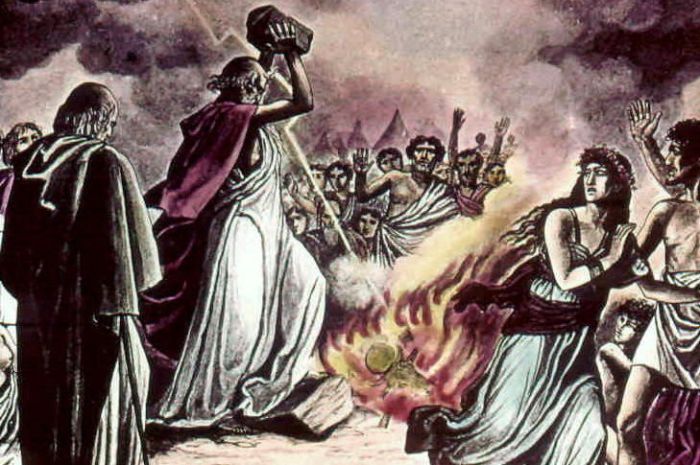
Image credit: Outset Ministry


Sermon Text – Exodus 32:1-14


When we gather as church, whose promise do we trust?

God’s? Or our own?

The people of Israel had seen God’s promise in action, in ways that were so dramatic their children’s children’s children would still tell the stories. It is the same story that we, their spiritual children, are still telling 3,500 years later. They were in bondage in Egypt – and the Lord God miraculously set them free. They were chased by a Pharaoh whose heart was hardened, by an army they could not hope to defeat – until the Lord God parted a sea, and they walked over the dry land. And when they turned back to look from the far bank, they saw the Egyptian army swallowed by the collapsing walls of the sea and drowned. They were hungry in the wilderness, and the Lord God caused mana, bread from heaven, to appear on the ground for them to eat. They only had to gather it up. When they were thirsty in the parched desert, the Lord God gave them water springing out of a bone-dry rock. When they were lost, the presence of the Lord God appeared to them in pillar of cloud by day and a pillar of fire by night to show them the way. And when they lacked instruction, the Lord God gave them the Ten Commandments, made an lasting covenant with them, and the people said with a single voice, “We will do everything that the Lord has commanded.

But God calls them a “stiff-necked” people.

They complain about the food that they’re provided. Before the Lord provides it through the rock, they complain about the lack of water. They complain about their deliverance; they wish that they were still alive and slaves in Egypt rather than die in the desert.

And now, at Mount Sinai, at the mountain where God is making more promises to them and giving them more instruction – they reject him. Moses is on the mountain for forty days, and they’re getting restless. They’re anxious. They’re afraid – even after all that they had seen. Because Moses had not come back, and even though they should know where he is – on the mountain! – and what he’s doing – communing with their God! – they claim they do not know what has happened to him. Their lives in Egypt as slaves were so regimented, their daily tasks all laid out by overseers, that now in their freedom any symptom of uncertainty spreads as an epidemic. The evidences of God’s presence is still around them – they saw what was going on at Sinai; they were still daily gathering the mana!

Yet their own disbelief had taken hold. “Make us gods!” they tell Aaron.

It’s not that this god they demand Aaron to make is easier to serve. They rip rings off the ears of their wives and their children and give them up freely, en masse to build it. This god they make requires sacrifice, and they willing make this sacrifice for one reason: this god is a god they can control.

This god is a god made by them.

And when the god of the golden calf is made, and they make their sacrifices, their anxiety is relieved. They “worship” – at least they think they’re worshiping. They eat. They drink. They play games. They revel.

They no longer have to wait for a God they can’t control. They’ve made a god themselves. They no longer have to wait for a leader to come down from the mountain. They have complete sway over another leader, a leader who should know better, but who follows the wills of the people rather than the will of God. Their anxieties are lifted because they’ve broken away from the God who demands they follow, and they are now eagerly charting out their own path, a path – as we see in the rest of this passage – that leads to death. They have abandoned the promise of God for the promises they’ve made to themselves.

When we gather as church, whose promise do we trust?

God’s? Or our own?

Are we less stiff-necked than they are?

There’s no doubt we have anxiety in the American church today. We look at numbers that have been declining since the 1960s. At our presbytery meeting on Friday, the moderator for the General Assembly of our denomination, the Rev. Dr. David Lancaster, pointed out this anxiety by bringing our attention to a less looked at statistic. Every year churches report numbers to the denomination, and almost every year, under the column heading for “confessions of faith,” the numbers remain “one” or “zero” for most churches. The anxiety is how are we going to “survive” when we aren’t proclaiming the gospel to the lost.

I know you feel that anxiety here, because like many churches in the Cumberland Presbyterian Church, you are without a pastor. I’ve been a member of churches without pastors. I’ve sat on a pastoral nominating committee. I know the anxiety that comes without knowing who will lead the church. I know the anxiety that comes with wondering what directions the church I love will take in the future. It’s a difficult time for any body of faith. You wonder, “What will the future of Coker Cumberland Presbyterian Church be?” We wonder, “What will the future of the Cumberland Presbyterian Church be?” We wonder, “What will the future of the Church be?”

Sisters and brothers, the hard truth of this passage for us is this: beware this anxiety that we feel. It leads to idolatry. And idolatry leads to death.

It is tempting for us to say in our uncertainty, “What should we do?!” But truth is everything that is required for us to do has been spelled out for us. And in asking that question, we want to make ourselves masters of the church’s destiny, not Christ, our bridegroom. And that is idolatry.

There is nothing wrong with church programs, especially for church programs aimed at evangelism and discipleship. But when you make the mistake of thinking those programs are going to save the church, you make them into an idol. There is nothing wrong with a more contemporary style of worship. But when you think that if you don’t put up screens, or if you don’t buy a drum-set, or if you don’t make an effort to look hip or cool that the church will die! – then you’ve made that form of worship an idol.

There is nothing wrong with desiring and praying for a godly pastor to lead your church. If it were, I’d be out of job! But when you think a pastor is going to come and save your church, you’ve made a pastor your idol, and you’ve denied that your church already has a savior. I’ve seen the job descriptions churches make for pastors – I haven’t seen yours, so it may not apply here! – but I’ve seen plenty to know that the savior-pastor is exactly what so many churches are looking for. The list of requirements is long, diverse, and so much of what the church should do and must do collectively is put individually on the pastor.

And this is idolatry. These things are idolatry because, like the golden calf, it takes away the hard work of waiting, of being dependent on a God who is not you, and it allows you to be free from anxiety because you are the one who can do the work. If you follow this church-growth plan, if you change your worship style in this way, if you hire this pastor, if you build this building – all of your problems about the future of the church will have hope . . .

. . . not godly hope . . .

. . . but a hope that we can manufacture ourselves.

And hope that we can control is always the hope that we prefer – even at the expense of the true hope we have in Jesus Christ.

Church of Christ, we must not dare replace the hope we have in the promise of Christ for the hope we manufacture ourselves. Changes in style, in leadership, in method to reach a contemporary culture are not in-and-of themselves evil. I am not advocating that the Cumberland Presbyterian Church or this church here at Coker keep doing things the same way! There are many places in which I’d argue the opposite. Israel’s gold was not itself evil. The tabernacle had golden objects all over it. The rings of gold were fine when they were on the wives and children of Israel. But the minute changes in the church become the objects of our hope, we commit idolatry. And idolatry leads to death.

The last portion of this passage is notoriously difficult to understand. And I think in some ways it’s meant to be – so, I hope to let some of the tension in this passage remain. What we see in the interchange between God and Moses is a demonstration of a God who is both just and gracious. He is both righteous and loving. He is both holy and intimately connected to his people.

Their turning away should prompt him to turn away. That’s why in verse 8, God tells Moses that they are your people . . . Moses’ people . . . not God’s. The righteous requirement of God compels him to stamp out evil, to destroy it, to obliterate it because even in the very sight of the holiness and the provision of God, the people have turned inward to worship themselves.

This is certainly a time of testing for Moses, just as these are times of testing for leaders in our church.

And Moses’ response – which is so unlike most of our responses to our current problems – is to pray.

His first instinct isn’t to go down on his own. His first instinct isn’t to set things right. It isn’t to fire Aaron and hire a new priest. His first instinct isn’t to find new ways to incorporate this idolatry in their worship so that he won’t lose members. His first instinct is to pray.

He prays.

He prays reminding God of God’s own promises. And I think he prays them not so much to remind God but to remind himself. In this testing of Moses’ faith, Moses is compelled to remember God’s character. God is the righteous judge who passes the correct sentence of destruction for an idolatrous people – and then suspends the sentence. There is a dance going on here between Moses and God – a God who is indeed eternal and unchanging – that forces Moses to remember who God is and shows Moses that God truly does hear our requests. And when they are in accordance with God’s will – as Jesus taught us to pray – God’s will is indeed done.

And we know God’s will for the church.

Jesus says, “I will build my Church. And the gates of hell shall not prevail against it.

Individual churches will close. Whole denominations will die. But Christ’s church will last forever because Christ wills it to! And the knowledge of this promise does not compel us to sit tight, but to work productively. To work in faithfulness. To rest, even as we work, in the full sufficiency of Jesus Christ. The saving of souls is God’s business, and God’s alone. And by his grace we are given the privilege of participating – people in pulpits and pews alike – by preaching the gospel. When he sends us out, he does not send us out alone, but God’s very Spirit dwells within us and is compelling those to whom we preach.

And when we fail, when our churches close, when we worry about the future, Christ still intercedes for us. Our Lord Jesus Christ, though he has ascended to the heavenly mountaintop, is surely coming again! Come, Lord Jesus! When we fail and follow idols, his pierced hands and feet cry out for us and on our behalf: “Look. I have bought these people, my church, for the price of my precious blood. They are mine. And the gates of hell shall not prevail.”

Amen.

Word, Water, Spirit, Touch

The following is the sermon manuscript I used on October 1, 2017, the Seventeenth Sunday after Pentecost. It will vary in places from the actual sermon preached.

For more on this series, see our Introduction


Sermon Text – Acts 18:24-19:10


The Holy Spirit of God is not tame. And that should humble us.

We are at a transition point in Acts, one that begs us to consider what it means to be instructed by the Scriptures, what it means to be baptized in the name of Jesus, what it means to be touched – to be in fellowship – with our sisters and brothers in Christ. At the center of this three-fold working of water, word, and touch is the Spirit of God pointing us to Jesus in power. The Scriptures are important, but if the Spirit does not use the Scriptures to point us to Jesus, then we have no knowledge. Repentance and baptism are important, but if it is not done with the Holy Spirit in the name of Jesus, it is not a holy moment, a sacred moment, a sacrament. The intimacy of community is important, but if that intimacy does not come from shared, humble communion by the Spirit in the name of Jesus, it is not a congregation.

At the extremes in this passage are, on one end, Apollos and twelve newly baptized. On the other end are the unbelieving people of the synagogue at Ephesus. In the center are Priscilla, Aquila, and Paul being worked by the Spirit to overturn worlds. At one end are people who are close to the kingdom in fullness; at the other, people who think they are close push themselves further away. At one end, people who have knowledge – who really do have an understanding of the truth – humble themselves to receive more accurate instruction; at the other, people who think they have knowledge allow their stubbornness to reject the truth at the cost of their salvation. The Holy Spirit is at work, moving where the Spirit wills to move. Those who are following the Spirit follow further. Those who are rejecting the Spirit push themselves further away.

When we last left Paul, he was in Athens. He was in the middle of what’s known as his second missionary journey – that’s in the book of the maps there at the end of some your Bibles. He’s been moving up from Antioch in Syria, the place where the first Christian community outside of Israel was visited by the apostles, northwest up into modern-day Turkey and into Greece. Athens is not too far from the port city of Corinth, which you may remember from the letters Paul wrote to the church there, where Paul meets Priscilla and Aquila. This is the missionary couple who had fled to Greece from Italy as refugees when the Roman emperor Claudius was persecuting the Jews in Rome. In Corinth, Paul, Priscilla, and Aquila all make tents. All three preach the gospel. And all three sail from Corinth east across the Aegean Sea to Ephesus. Paul leaves Priscilla and Aquila to return to the place where this missionary journey started – Antioch in Syria – and the passage today marks the beginning of Paul’s third and final missionary journey before he is imprisoned and sent to Rome to die.

Derek and I have been leading you through this story, this history of the book of Acts by describing it as one Act of the Holy Spirit revealing the person of Jesus Christ to the whole world through many movements of the apostles and disciples, advancing the Kingdom of God to the ends of the earth. Derek and I have counted 85 such movements through the highly scientific process of counting ESV section headings. If you’ve been counting along with us, and I know you haven’t because even I had to look this up on the worship plan we made, these are movements 59 and 60. The geography is important – it marks real places where real people lived who were saved into a real community of Christians by the very real Holy Spirit in the name of the very real, resurrected Jesus Christ. The movements are important, because it involved real disciples proclaiming the real good news in real time periods of real history. The movements involved real work, real danger, real sacrifice. But the numbers of the movements or the geography aren’t what I would ask you if I were to quiz you on this book. I would want you to remember the number one – One Actor, the living God. One Lord, Jesus Christ. One Act, the spread of the gospel to the world.

And the Actor is not tame. The Spirit of the living God moves us, not the other way around. And this should humble us.

We all have that friend on Facebook – some of us still have that friend in the real world. That friend who is as stubborn as the day is long . . . but not just stubborn – wrong and stubborn. Boy did last year bring these folks out! I don’t care who you voted for, you know what I’m talking about. And I don’t care what issue you take today, what side you take (or if you take any side at all) – from Trump to the National Anthem at a football game to the response to Hurricane Maria in Puerto Rico – you know that friend of yours who is absolutely wrong and no matter how much you try to convince him he’s not going to change his mind on it!

Especially not on Facebook where it’s easy to forget that the person who’s arguing with you in a flesh and blood human being with hopes and fears and wants and dreams just like you. People are stubborn. We’re especially stubborn when we think that we’re right about something. I joked about giving a quiz earlier, but chances are if I did give a quiz, and you got some answers wrong, some of you would argue with the question! I know because I’ve done the same thing before!

At heart, we all have what’s called a confirmation bias. So many of the things we’re convinced we’re right about, we’re only convinced because we’ve only looked at sources that confirmed what we already thought was true. We only look for evidence that we want to find, and if we do find evidence that’s contrary to what we think is true, we often dismiss it before we understand it.

We must value the truth and hold that truth does mean something – I’m not arguing for the opposite of that or for relative truth. But what I am saying is that you may be wrong. I may be wrong. And we all need to be corrected.

This confirmation bias doesn’t happen just in secular culture or politics. We celebrate this month the 500th anniversary of the Protestant Reformation, the movement started by Martin Luther that led to Christian groups to move away from the Roman church. In that time period, something like 30,000 Protestant denominations have started. That’s 30,000 groups that differ in either doctrine, history, or geography – or some combination of the three. For us and our sister denomination of Cumberland Presbyterians, it’s a separation that started as segregation because of race.

The Holy Spirit does not move in 30,000 different directions at once. We do. And while there is much to celebrate this month about the Protestant Reformation, there is also a lot for us to be convicted about, too. We are not a humble people, willing to listen to instruction by the Spirit. Instead, we prefer to argue, to split, to sue, and to separate.

No, the Holy Spirit of God is not tame. And that should humble us like it humbled Apollos.

Apollos was an educated man who allowed refugees to teach him the Scriptures more accurately. As a man, he was a Jewish leader – and in that very patriarchal society he learned from a woman and her husband who had a better understanding of the Scriptures than he did. He was a bold, passionate man – but, like Jesus, he did not see humility as something that made him weak. He was led by the Spirit, and he had surrendered himself enough to know that the Spirit was leading him into community. This was not just Apollos and his Bible, and his only interaction with other people was not simply telling them how wrong they were! The result of his humility was greater boldness! The result of his humility was greater intellectual prowess! But these things were only tools used by the Spirit to convince people that Jesus is the Christ. Only the humble allow themselves to be moved by the Spirit in this way. Only the humble can be convicted by the reading of the word in the presence of community and find a changed life to God’s glory.

The Holy Spirit of God is not tame. And that should humble us like it humbled the twelve in our passage who were baptized.

Notice, I did not say re-baptized – that’s not what’s going on here. There is no magic formula. The reason their first baptism was insufficient (good as it may have been) was not because of the pattern of a ceremony, but because of a person. They were baptized in repentance that led the way for Jesus. Now Jesus had come. And they needed to share in his baptism. They needed to share in his death. They needed to share in his resurrection. And they go humbly.

In quiet humility, they are led by the Spirit through Paul into baptism. The result of their humility is boldness – they receive the Holy Spirit in power. In an echo of the twelve apostles at Pentecost these twelve foreign disciples are touched by the Christian community in the hands of Paul. They speak in tongues, and they prophesy.

Too often, we get this so wrong. We think baptism is about us. I see people who were baptized in the name of the Father, Son, and Holy Spirit get re-baptized all the time. This may seem like an act of humility – someone is admitting that they themselves or someone else didn’t get it right the first time. I confess that I cringe whenever I hear someone tell a newly baptized person, “Congratulations!” or worse, “I’m so proud of you!” In this lack of humility or faux humility we make baptism about us! Brothers and sisters, baptism is about Jesus. That’s why, and it’s the only reason why it has any affect at all! The difference in this text is in the name of the community into which the person is being baptized. It has nothing to do with the people being baptized. And if you are ever tempted to doubt your baptism, do not look to yourself, to the age when you received it, or to the one who performed it. Look to the name that was pronounced over you – look to the name of Jesus.

Do not be stubborn, like the people in the synagogue. Do not reject the Holy Spirit and find yourself isolated from the touch of the community, the water of your baptism, the word of God proclaimed in the congregation. Instead, as Paul proclaims in Philippians 2, look to Jesus and in humility learn from him:

In your relationships with one another, have the same mindset as Christ Jesus:

Who, being in very nature God,
did not consider equality with God something to be used to his own advantage;
rather, he made himself nothing
by taking the very nature of a servant,
being made in human likeness.
And being found in appearance as a man,
he humbled himself
by becoming obedient to death—
even death on a cross!

Therefore God exalted him to the highest place
and gave him the name that is above every name,
that at the name of Jesus every knee should bow,
in heaven and on earth and under the earth,
and every tongue acknowledge that Jesus Christ is Lord,
to the glory of God the Father.

Amen.